9 Engaging Vocabulary Board Games for 8+ Year Olds That Make Reading Fun
Jump to:
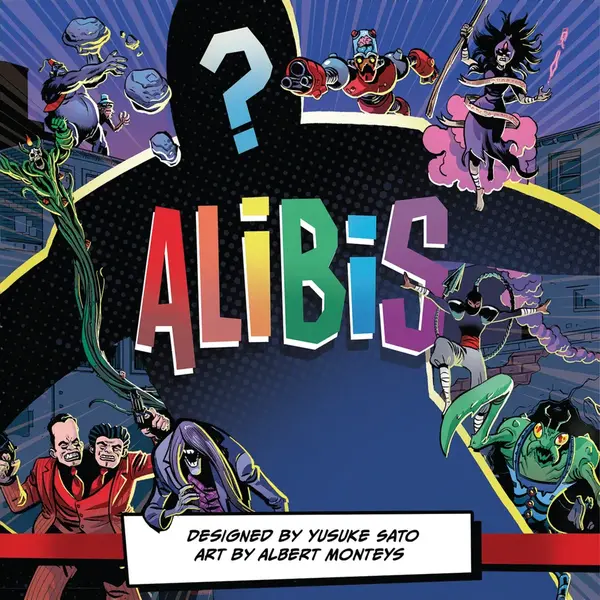
Alibis – Cooperative deduction word game, finding a single word to connect words.
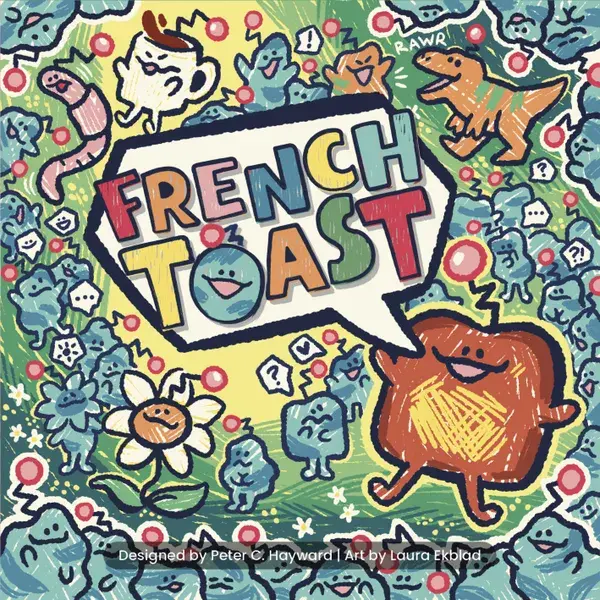
French Toast– Shout random words to guess the secret word.
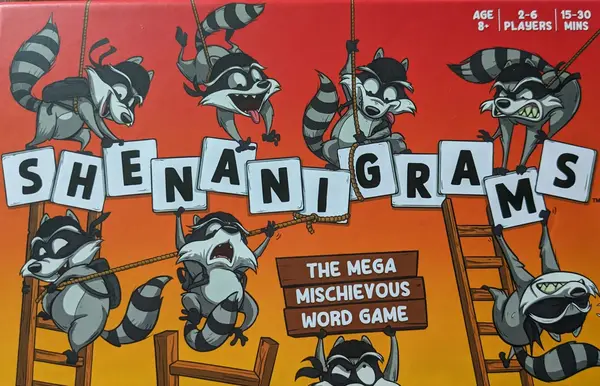
Shenanigrams – a fun twist on Scrabble with some special actions where you can “steal” others’ words.
Just One – Cooperative word guessing game, but no two players can write the same word.
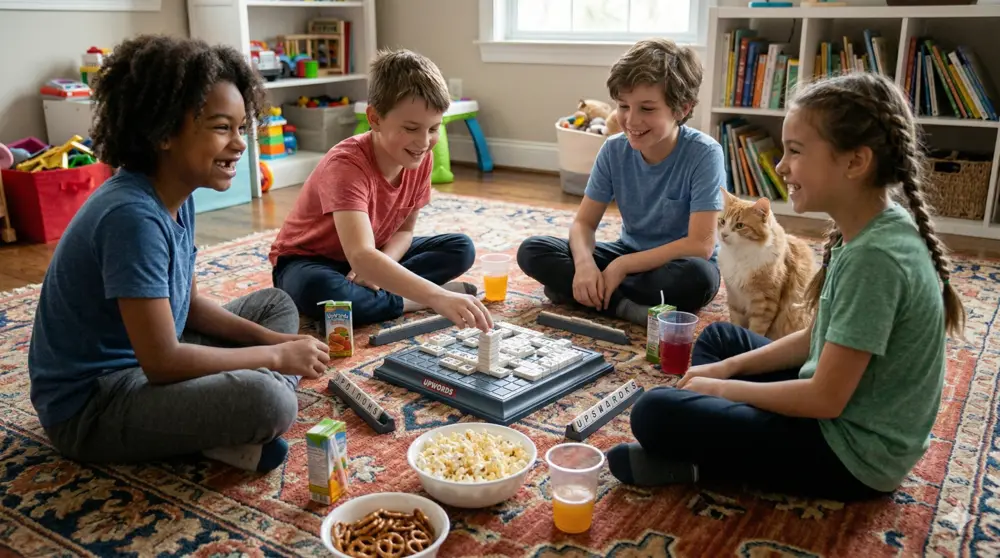
Upwords—a fun Scrabble-type game, but where you can stack ontop of letters to create new words.
If you’ve ever sat down for a “fun” family game of Scrabble only to have your children melt down because they can’t find a place for their “Q,” or they ended up with tough letters, you aren’t alone. As a parent its hard to find the middle ground between “too babyish” and “too frustrating” when searching for word / vocabulary board games for 8 year olds +.
This age is a critical turning point; according to the National Literacy Trust, play and language are completely intertwined, serving as the essential “building blocks” for a child’s meaningful communication.
By utilizing engaging word games for kids, you aren’t just filling an afternoon—you are providing a high-quality educational game for 3rd graders.
Recent findings published in the Journal of English Language Proficiency (2024) confirm that integrating word games into a child’s routine can lead to a significant increase in average vocabulary scores and long-term word knowledge. These board games that boost language skills help transition children from simply “sounding out” words to understanding the nuance and context of the English language.
Here are the best recently published and classic engaging word games to transform your family game night.
Vocabulary Board Games for 8-Year-Olds and Up
Alibis
- Game Type: Cooperative Deduction
- Players: 2–6
- Game Time: 20 Minutes
- Age Rating: 10+
- Objective: Work together to link secret words using limited clues.
How to Play Alibis
Alibis is a cooperative word-association game where your goal is to clear the “heat” by connecting secret suspects with clever clues. Work together over three rounds to identify the perpetrator and prove you are Marvelous Masterminds.
Game Setup
First, give every player one alibi tile, one deduction board, and a marker. Once everyone is equipped, follow these steps to prepare the play area:
Prepare the Heat: Place the perpetrator board to the side. Refer to the table below to pile the correct number of heat tokens next to it.
Organize Suspects: Lay out the numbered suspect boards in the center. Shuffle the word cards and deal one face-up onto each board.
Assign Roles: Locate the suspect cards that match the numbered boards. Shuffle them and deal two cards face-down to each player. Place the single remaining card face-down on the perpetrator board—this is your perpetrator.
Start: Randomly choose a first player.
| Players | Suspects Used | Heat Pile |
| 4 | 1–9 | 32 |
| 5 | 1–11 | 40 |
| 6 | 1–13 | 48 |
Round Structure
Every round consists of three distinct phases. You must work efficiently to narrow down the suspects before the rounds conclude.
Phase 1: Create Alibis
To begin, look at your two secret suspect cards and find their matching words on the boards in the middle. Your task is to come up with a one-word clue that connects those two suspects.
Example: If your words are “Horse” and “Spring,” you might write “Chicken” on your alibi tile (referencing a farm and the phrase “spring chicken”).
Phase 2: Share and Guess
Next, starting with the first player and moving clockwise, everyone reveals their alibi tile and reads their word aloud.
As you listen to your teammates, use your deduction board to secretly mark which two suspects you believe they hold. Once you have narrowed down all other players’ suspects, mark the remaining suspect with a “P” for Perpetrator.
Phase 3: Reveal and Score
After everyone has finished guessing, players reveal their cards one by one. Scoring happens as follows:
Teamwork: If at least one person correctly guessed both of your suspects, remove 1 heat from the pile.
The Perpetrator: Finally, reveal the card on the perpetrator board. For every player who correctly identified the perpetrator, remove 3 heat from the pile.
Winning the Game
The game ends after three rounds or immediately if the heat pile is empty. To determine your success, count the remaining heat tokens and check your ranking:
- 0 Heat: Marvelous Masterminds
- 1–4 Heat: Smart Sidekicks
- 5–9 Heat: Middling Minions
- 10–14 Heat: Low-level Lackeys
- 15+ Heat: Unimpressive Underlings
This is a fun light hearted word guessing game.
French Toast
- Game Type: Rapid Comparison / Party
- Players: 2–10
- Game Time: 5 Minutes
- Age Rating: 6+
- Objective: Guess the secret word through a series of “more like this” comparisons.
How to Play Toastmaster
In this cooperative guessing game, one player acts as the Toastmaster while everyone else tries to uncover a Secret Word. You have six rounds to identify the word before time runs out!
Setup
To begin, assign the role of Toastmaster. If it’s your first game of the day, the person who most recently ate toast takes the lead. Otherwise, choose the player who last guessed a Secret Word correctly.
Secret Word: The Toastmaster draws one card and keeps it hidden.
Hint Scale: Place the six Scale cards in a row, ranging from “IS” to “IS NOT.”
The Deck: Shuffle the Hint cards and place them face-down near the Toastmaster.
Goal
Work together to guess the Secret Word. If the group fails to identify the word by the end of the sixth round, everyone loses.
Round Overview
Each round follows a specific sequence of giving clues and making rapid-fire guesses:
1. Giving a Hint
The Toastmaster draws six Hint cards and chooses one to reveal. They place this card under a position on the Hint Scale to show how well it describes the Secret Word.
Adjustments: The Toastmaster may also move any previously placed hints to new positions on the scale.
Discard: The five remaining cards are discarded face-down.
2. Starting the Timer
Before the timer begins, players may discuss the new hint. When the group is ready, the Toastmaster announces the closest previous guess and starts a 30-second timer.
Note: In Round 1, “French Toast” is always used as the starting “closest guess.”
3. Making Guesses
During the 30 seconds, players may shout out any number of guesses.
One at a Time: Players must wait for the Toastmaster to respond before making a new guess.
The Response: For every guess, the Toastmaster must say either the new guess or the previous closest guess—whichever they feel is more similar to the Secret Word.
Equality: If the Toastmaster cannot decide, they may say “Equal.” This provides info but does not change the current “closest guess.”
Game End
Winning and losing is decided by your speed and accuracy:
Victory: If any player says the Secret Word (or a phrase containing it) before the timer hits zero, everyone wins immediately.
Round End: If the timer runs out, the round ends. The closest guess from that round carries over to the start of the next one.
Defeat: If the players have not guessed the word by the end of the sixth round (when all six Scale cards have hints under them), the game ends in a loss.
Shenanigrams
- Game Type: Competitive Word Building
- Players: 2–6
- Game Time: 15–20 Minutes
- Age Rating: 8+
- Objective: Build words and “steal” them from opponents to reach a point goal.
How to Play Shenanigrams
Shenanigrams is a fast-paced word game where players build a shared grid of letters, completing and stealing words to be the first to place all their tags.
Setup
Before the first letter is played, every player takes a privacy shield to hide their tiles.
Draw Tiles: Shake the bag of tiles. Each player draws five tiles and places them behind their shield.
Assign Tags: Choose a color and take the appropriate number of tags based on the player count:
- 2 Players: 7 tags
- 3 Players: 6 tags
- 4 Players: 5 tags
- 5–6 Players: 4 tags
Determine Order: Each player draws a random tile from the bag. The person who draws the letter closest to “Z” goes first. Return these tiles to the bag before starting.
Playing the Game
The first player places one tile in the center of the table and draws a replacement tile from the bag. Afterward, play continues clockwise.
On your turn, you must place one tile from your hand into the grid. It must be placed adjacent (up, down, left, or right) to a tile already on the table. Every tile played must either complete a word or be a clear step toward completing a valid word.
Valid Words: Use any word found in a standard dictionary. You may not use abbreviations, proper nouns, or words requiring hyphens or apostrophes.
Word Reveal: If other players don’t recognize the word you are building, you must reveal it. If it is invalid, you must take back your tile and lose your turn.
Refreshing Tiles: If you cannot play a letter, you may discard your entire hand and draw five new tiles, but this uses your entire turn.
Tagging a Word
When you place a tile that completes a word of three or more letters (reading left-to-right or top-to-bottom), you tag it. Place one of your colored tags on the word to show you are the current owner.
Stealing a Word
The heart of the game is taking ownership of words previously tagged by opponents. You can steal a word in three ways:
Add a Letter: Place a tile at the beginning or end of a tagged word to create a new, longer word (e.g., turning “OLD” into “GOLD”).
Replace a Letter: Swap a letter in a completed word with one from your hand to create a new word (e.g., changing “GOLD” to “SOLD”). Discard the old tile.
Insert a Letter: Slide a new letter into the middle of a completed word and shift the existing tiles to make room (e.g., turning “SOLD” into “SOLID”).
When you steal a word, return the previous owner’s tag to them and replace it with your own. You can even steal multiple words in one turn if your single tile placement validly changes two intersecting words.
Winning the Game
The game reaches its climax when a player places their final tag on the board.
The Shout: The player must shout “Shenanigrams!” and immediately begin a five-second countdown.
The Last Chance: The very next player has exactly five seconds to steal any of that player’s words.
Victory: If the next player successfully steals a word within the time limit, the game continues. However, if they fail, the player who placed all their tags is crowned the winner.
This is a super fun game, where words are constantly changing and the winner can change at any time. However, if you have a sensitive child, this may not be the best game, as there is the ability to “steal” words.
On the other side of that, this will teach children some resilence and patience and possible bring out that competitive side.
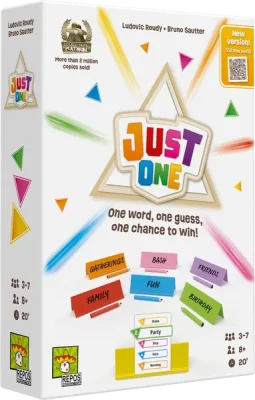
Just One (2025 Refresh)
- Game Type: Cooperative Word Guessing/Clue Game
- Players: 3–7
- Game Time: 20 Minutes
- Age Rating: 8+
- Objective: Help one player guess a mystery word using unique clues.
How to Play Just One
Just One is a cooperative party game where you work together to discover as many mystery words as possible. The catch? If two players write the same clue, those clues are canceled and hidden from the guesser!
Round Overview
Each turn follows a simple four-step process to help the active player guess their word.
1. Mystery Word Selection
The active player draws the top card from the deck and places it on their easel facing the other players. Without looking at the card, they choose a number between 1 and 5. This identifies the mystery word for the round.
2. Clue Selection
Every player (except the guesser) writes one single word on their easel to help describe the mystery word.
Allowed: Numbers, acronyms, onomatopoeia, and special characters (e.g., “007,” “SMS,” or “$”).
Forbidden:
The mystery word itself (even if misspelled).
The word in a foreign language.
Words from the same family (e.g., “Prince” if the word is “Princess”).
Invented words.
Homophones (e.g., “Weather” if the word is “Whether”).
3. Comparing Clues
Once everyone is ready, the active player closes their eyes. The other players compare their easels. Any identical or invalid clues are removed by tipping those easels over.
Important: Clues are considered identical if they are the same word, plurals, different genders of the same word, or spelling variations.
4. The Guess
The active player opens their eyes and looks at the remaining clues. They have only one guess to identify the mystery word.
Success: If the guess is correct, the card is placed face-up next to the deck as a point.
Failure: If the guess is wrong, the current card and the top card of the deck are removed from the game.
Skip: If the player chooses not to guess, only the current card is removed.
End of the Game
The game continues until the deck is empty. Count your successfully guessed cards to see how your group performed:
| Correct Cards | Rank |
| 13 | Perfect score! |
| 11–12 | Incredible! |
| 9–10 | Awesome! |
| 7–8 | Average (Not bad!) |
| 4–6 | Good start. Try again! |
| 0–3 | Try again and again. |
We love the cooperative aspect of this game. I also enjoy seeing the cool clues my kids think of.
Be flexi, you can play for as long as you like and we dont score. Its all about the laughs in between.
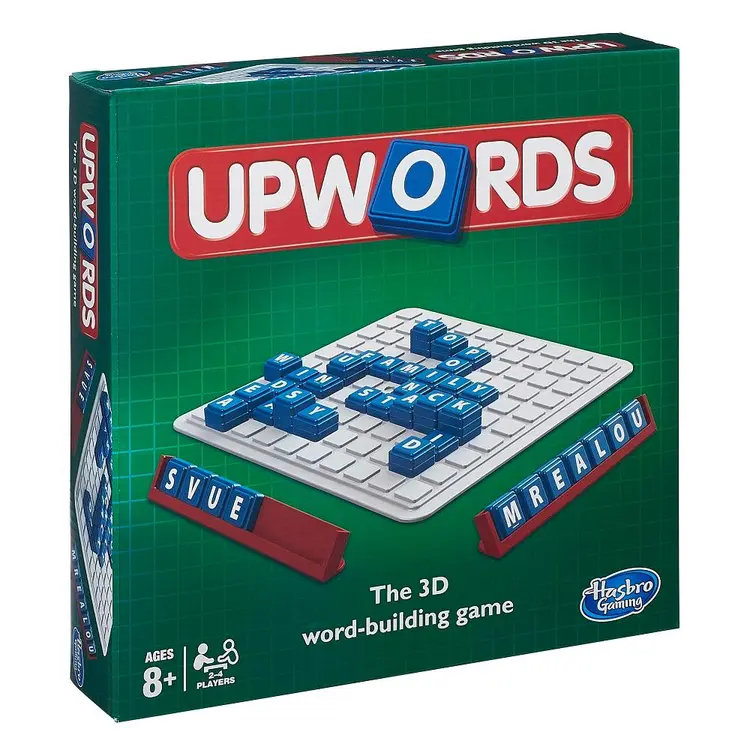
Upwords
- Game Type: 3D Strategy / Spelling
- Players: 2–4
- Game Time: 30+ Minutes
- Age Rating: 8+
- Objective: Score the most points by building and stacking words.
How to Play Upwords
Upwords is a 3D word-building game where players don’t just play across the board—they stack letters on top of each other to change existing words and reach new heights.
Setup
Prepare the game by assigning a scorekeeper and determining the starting player.
Initial Draw: Every player draws one tile from the bag. The person with the letter closest to “A” goes first. Return these tiles to the bag.
Starting Hand: Each player draws seven tiles and places them on their rack.
The Bag: Place all remaining tiles in the bag. Keep a dictionary nearby strictly for settling word challenges.
Playing the Game
Players take turns in clockwise order. On your first turn, you must form a word of at least two letters that covers one of the four central squares.
Every Turn
On your turn, you may perform one of the following actions:
Play a Word: Add one or more tiles to the board to form at least one new word.
Exchange: Swap one tile from your rack for a new one from the bag. You must skip the rest of your turn as a penalty.
Pass: Skip your turn entirely.
Stacking Rules
Unlike other word games, you can stack letters vertically to change a word (e.g., stacking a “W” on the “M” in “MOOD” to create “WOOD”).
Visibility: You cannot stack over an entire word; at least one letter from the previous word must remain visible.
Height Limit: A stack cannot exceed five tiles high.
No Same-Letter Stacking: You cannot place a letter (e.g., an “A”) directly on top of the exact same letter.
Plurals: You cannot simply add an “S” to an existing word to make it plural. However, you can play a full new word that happens to connect to an existing word and make it plural.
Scoring
Points are calculated based on the height and length of the words formed.
Flat Words (1 tile high): Score 2 points per tile.
Stacked Words: Score 1 point per tile. This includes every tile in the stack underneath your new word.
Bonus – Qu: Score 2 extra points if you use “Qu” in a word that is only one tile high.
Bonus – Seven Tiles: Score 20 extra points if you use all seven tiles from your rack in a single turn.
Challenging a Word
If you believe a word is illegal (proper nouns, abbreviations, or hyphenated words), you must challenge it before the next player takes their turn.
Illegal: If the word is found to be invalid, the player must remove their tiles. After two failed attempts at a word, the player loses their turn and scores zero.
Winning the Game
The game concludes when a player uses all their tiles and the bag is empty, or when all players pass in succession.
- Final Tally: Sum all points earned during the rounds.
- Penalty: Deduct 5 points for every tile remaining on your rack.
- Victory: The player with the highest total score wins.
Conclusion - Vocabulary Board Games for Children
The secret to building a robust lexicon isn’t found in a dry dictionary; it’s found in the social connection of vocabulary board games for 8 year olds. By choosing cooperative word games like Alibis or Just One, you allow children to explore synonyms and abstract thinking in a low-anxiety environment. As Edutopia (2024) points out, board games act as a “low-stakes assessment” tool, letting kids demonstrate their understanding in a relaxed setting that fosters critical thinking and teamwork without the pressure of a grade.
Furthermore, Red Apple Reading highlights that children who regularly participate in word games show improved reading and speaking fluency compared to those who do not. These best word games for family game night provide the rich, multisensory experiences necessary for the brain to form lasting linguistic connections. Whether you’re racing the clock or solving a spooky mystery, the right game will transform your child’s relationship with language. It’s time to clear off the table, put away the worksheets, and start playing your way to a bigger vocabulary.
References
- National Literacy Trust: The Power of Play to Boost Early Language
- ResearchGate: Improving Vocabulary Learning Using Word Games (2024)
- Edutopia: Using Board Games to Strengthen Literacy Skills
- Red Apple Reading: Can Word Games Increase Your Child’s Vocabulary?
Keep Building Skills with Board Games
Board games not only can help with vocabulary, but they can teach valuable other skills, like cooperation, team work with social deduction games and build attention span. Be creative with drawing games or strategy games.