
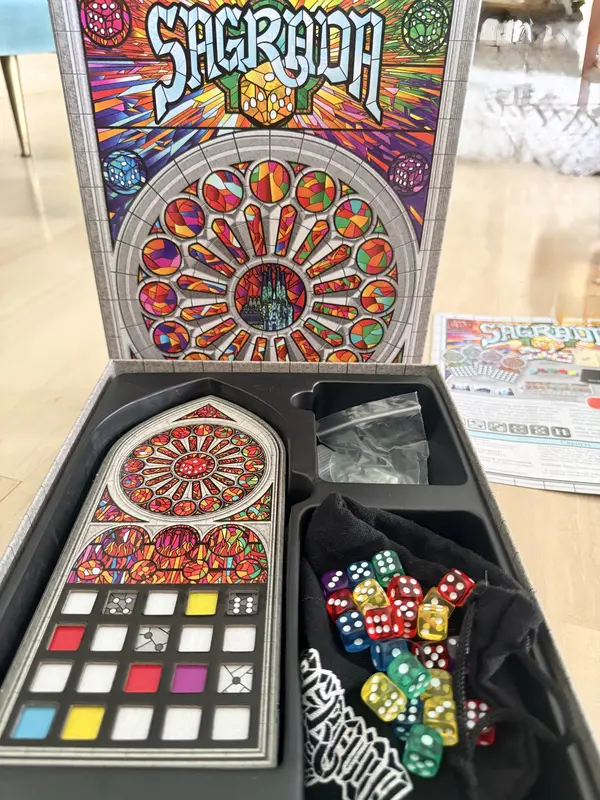
How to Play Sagrada - Family Guide
Looking for an easy guide on how to play Sagrada? You’ve come to the right place. Sagrada is one of the most beautiful dice placement games ever created, combining colourful stained-glass artwork with clever strategy. It’s easy enough to learn in around 10 minutes but offers plenty of tactical decisions that keep every game fresh.
At Quick Board Games for Families, we’ve found Sagrada to be one of those games that appeals to experienced gamers while still being welcoming for families and casual players. If you enjoy strategy, colourful components, and satisfying puzzles, this modern dice game deserves a place on your table.
Sagrada Game Stats
Before you begin, here’s a quick look at the game:
- Players: 1–4 players
- Play Time: Around 30–45 minutes
- Age Recommendation: 10 years and up
- Game Style: Strategic dice placement and pattern building
- Publisher: Floodgate Games
- Designed by: Daryl Andrews and Adrian Adamescu
Setting Up Sagrada
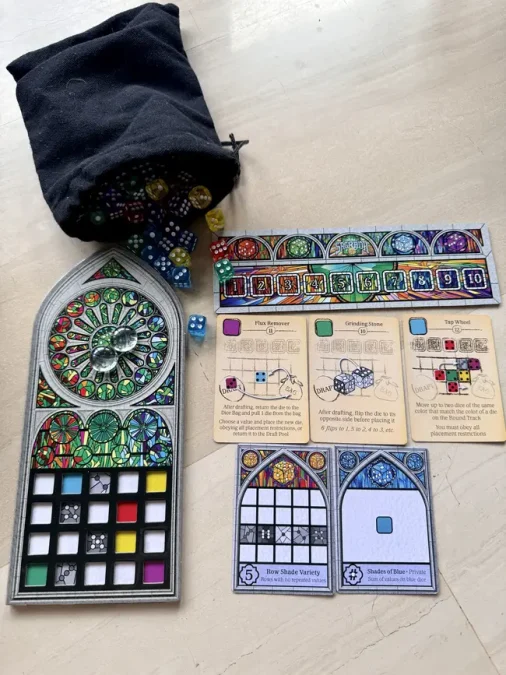
- Each player chooses a window pattern card.
- Select one side of the card to use.
- Every player receives a private objective card.
- Reveal three public objective cards.
- Reveal three tool cards.
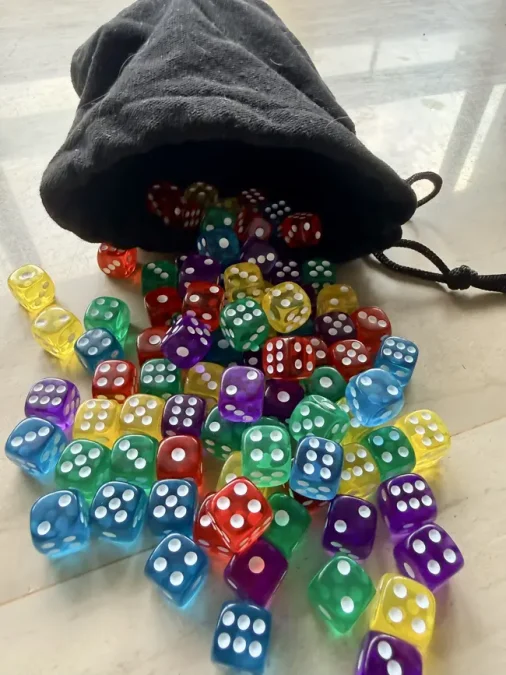
- Place all dice into the dice bag.
- Set up the round tracker.
- Randomly choose the first player.
You’re now ready to start building your stained-glass masterpiece.
How to Play Sagrada
Every game lasts 10 rounds.
Each round follows the same simple sequence.
Step 1: Roll the Dice
Roll a number of dice equal to:
Two times the number of players, plus one.
These become the draft pool for the round.
Step 2: Draft Dice
Players take turns selecting one die from the draft pool.
Once every player has taken a die, play reverses direction and everyone selects another die.
This “snake draft” means everyone places two dice each round.
Step 3: Place Your Dice
Every die must follow several placement rules.
You cannot place a die:
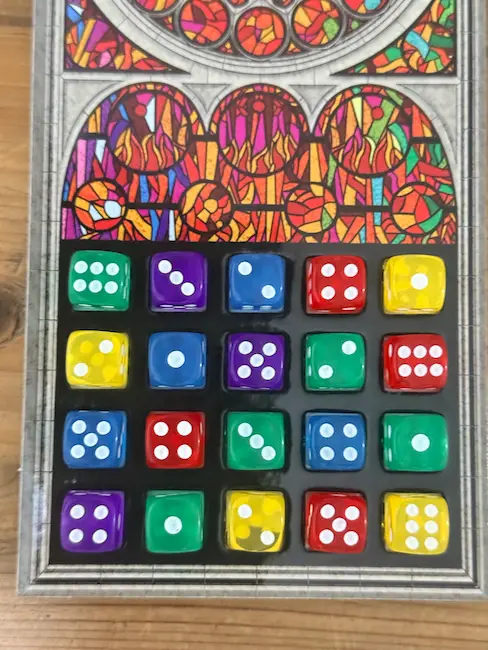
- Next to another die of the same colour.
- Next to another die showing the same number.
- Outside your window.
- In a space that doesn’t match the colour or number restriction printed on your window pattern.
Dice may touch diagonally without restriction.
Your very first die must be placed along an edge or corner of your window.
Step 4: Use Tool Cards
Tool cards allow players to bend the rules.
Examples include:
- Moving previously placed dice
- Changing die values
- Re-rolling dice
- Swapping dice
Using tool cards costs favour tokens, so timing is important.
Step 5: End the Round
Any unused dice are placed onto the round tracker.
After ten rounds, it’s time to score.
How Scoring Works
Players score points from several areas.
Public Objectives
These reward everyone for achieving specific patterns such as:
- Rows with different colours
- Columns with unique numbers
- Sets of specific die values
Private Objective
Your private objective rewards collecting one specific colour throughout your window.
Empty Spaces
Every empty space loses you one point.
Careful planning can make a huge difference during scoring.
Easy Strategy Tips for Beginners Plan Several Turns Ahead
Don’t just grab the highest number.
Think about where future dice might fit.
Protect Valuable Spaces
Some spaces become difficult to fill later.
Leave yourself flexible options.
Don’t Ignore Tool Cards
Many beginners forget to use them.
A well-timed tool card can completely change your score.
Watch Your Opponents
If someone clearly needs a certain colour or number, consider drafting it yourself first.
Avoid Empty Spaces
Losing points for unfinished windows can quickly undo great scoring opportunities.
Common Beginner Mistakes
Many new players:
- Ignore colour restrictions.
- Forget number restrictions.
- Block themselves too early.
- Spend favour tokens too quickly.
- Focus only on private objectives.
Balancing all scoring opportunities usually leads to better results.
While this seems like a lot to remember, don’t worry; just think that your first few times playing will be practice, and once you come to scoring, these will all make sense, and you’ll focus on these going forward. Just play and experiment the first couple of times to get the hang of the game.
Why Families Love Sagrada
Sagrada is one of our favourite family dice games because everyone builds their own colourful masterpiece. There’s no direct attacking, very little waiting between turns, and every completed window feels rewarding.
Although younger children may need some help understanding placement restrictions, older kids and adults can enjoy plenty of strategic decisions without the game becoming overwhelming.
It’s also one of those games that’s easy to teach but keeps improving every time you play.
Is Sagrada Mostly Luck or Strategy?
While dice rolls introduce some randomness, Sagrada is much more strategic than many traditional dice games.
Good players constantly adapt their plans, manage limited choices, and make the best use of tool cards. The dice create interesting puzzles rather than deciding the winner.
If you enjoy puzzle games, abstract strategy games, or modern family board games, you’ll likely appreciate the balance between luck and planning.
Frequently Asked Questions
How to Play Sagrada
Is Sagrada difficult to learn?
Not at all. Most families can learn the basic rules in about 10 minutes. The challenge comes from making smart decisions as the game progresses.
How long does a game of Sagrada take?
Most games last between 30 and 45 minutes, making it ideal for family game night.
Does Sagrada have replay value?
Absolutely. Different window patterns, public objectives, private objectives, tool cards, and dice combinations mean every game feels different.
Is Sagrada a good family game?
Yes. Sagrada is an excellent family strategy game for older children, teenagers, and adults. It encourages planning without being overly complicated.
Is Sagrada a board game or dice games?
It’s both. Sagrada is a dice placement board game, where colourful dice are the main game pieces used to build your stained-glass window.
Keep Exploring
- Dice Games Page
- Dice Games That Don’t Require a Board
- Risk Strike – All the fun of Risk but in a quick dice game.
- Heat: Pedal to the Metal – Car Racing Game
- How to Play Dragonwood – roll dice to capture creatures. Popular family dice, card game.