
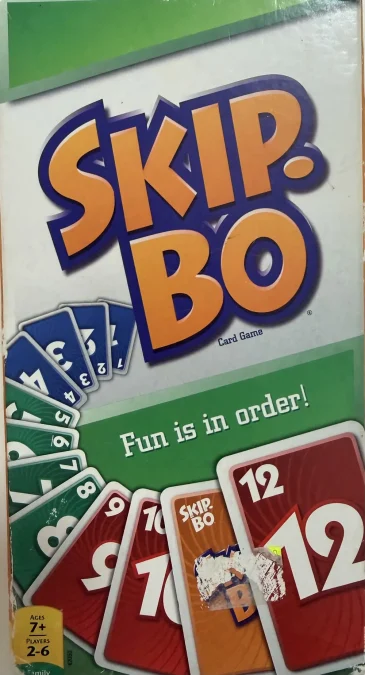
How to Play Skip Bo: There are few things my family enjoys more than clearing off the dinner table to make room for a stack of cards and some friendly competition. Among the many options in our collection, one title which we have had for years and years (thanks to a friend) is: Skip-Bo. It has become a staple in our home, providing hours of entertainment and just enough strategy to keep things interesting for players of all ages.
How to Play Skip Bo - Game Overview
- Publisher: Mattel
- Game Type: Card, Sequencing
- Number of Players: 2–6 players
- Age Rating: 7+
- Game Time: Approx. 20–30 minutes
- Designer: Hazel Rusden
Objective
The primary objective of Skip-Bo is to be the first player to successfully deplete your personal stockpile of cards. You do this by playing cards in numerical sequence (1 through 12) onto communal building piles in the center of the table. The game requires a combination of careful planning, card management, and strategic use of “Skip-Bo” wild cards to block your opponents while clearing your own cards as quickly as possible.
How to Play Skip Bo - Setup
Determine the Stockpile Size: Decide on the length of the game. For a standard game, deal 30 cards to each player; for a shorter game, deal 10 or 20 cards.
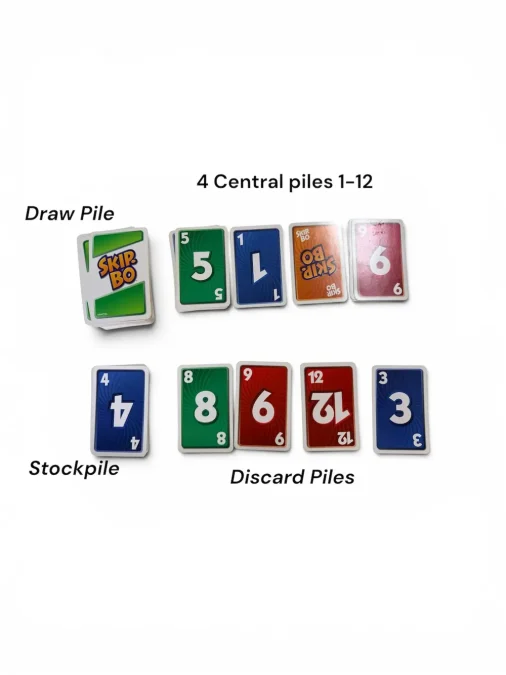
Create the Stockpiles: Each player places their deck of cards face-down in front of them to form their personal Stockpile. Only the top card of this pile should be turned face-up.
Prepare the Draw Pile: Place the remaining cards face-down in the center of the table to create the Draw Pile.
Designate Building Areas: Keep the space in the center of the table clear for up to four Building Piles. These are created during the game as players start sequences.
Establish Discard Piles: Each player has space next to their own Stockpile to create up to four Discard Piles throughout the game.
Once these areas are defined, the player to the left of the dealer goes first by drawing from the central deck until they have five cards in their hand.
While the basics are easy to grasp, the true charm of this game lies in the tactical details. Moving beyond the general overview, let’s take a closer look at the specific mechanics that keep the gameplay flowing and competitive.
In-Depth Gameplay Mechanics
To truly master the game, it helps to understand exactly how the different areas of play interact.
Starting the Turn: Always begin your turn by drawing cards from the central Draw Pile until you have five cards in your hand. If you start your turn with cards already in your hand, you only draw enough to return to five.
Building Sequences: You can play cards from your hand, the top of your Stockpile, or the top of any of your four Discard Piles. Sequences in the center must start with a 1 (or a Skip-Bo wild card) and continue numerically up to 12.
The Power of the Wild: The Skip-Bo card is incredibly versatile. It can be played as a 1 to start a building pile, or as any other number required to continue a sequence. Use these wisely, as they are your best defense against a stagnant board.
Managing Discard Piles: This is where the real strategy happens. You have four discard piles, and you can organize them however you like. During your turn, you can play cards from the top of these piles onto the central building piles. Remember, you must discard one card from your hand to end your turn, which adds that card to one of your discard piles for future use.
Clearing the Board: Once a pile reaches 12, it is “complete.” That pile is removed from the play area, and the cards are shuffled back into the main draw deck. This clears space for a new pile to be started, beginning again with a 1.
Taking Extra Turns: If you happen to play all five cards from your hand onto the building piles, you are immediately allowed to draw five more cards and continue your turn. This “chain reaction” is often how players make huge comebacks!
Essential Tips for Success
As you become more comfortable with the flow of the game, consider these strategic approaches:
Prioritize your Stockpile: Your main goal is to clear your stockpile. You’ll need to check if the top card of your stockpile can be played before using cards from your hand or discard piles.
Organize your Discards: I found trying to keep my discard piles organized by number if possible helps. If necessary, having one “junk” pile can be “useful”.
Watch your Opponent: Since this is a game of sequences, keep an eye on your opponent’s stockpile. You don’t want to place a 6 down if your opponent has a 7 on their stockpile.
- Use Wild wisely: I make sure my wilds advance myself so I can get to my stockpile card. I sometimes can hold onto them for a while, waiting for a sequence just so I can use my stockpile card.
With these additional rules in mind, you are well on your way to becoming the champion of your next family game night.

Frequently Asked Questions
Skip Bo Card Game
Is Skip-Bo a good game?
I think this is a fantastic choice for families and friends alike. Because the rules are straightforward, we found it accessible for younger players, yet the strategy involved keeps adults engaged. Its blend of luck and planning makes every game feel fresh and exciting.
Is Skip Bo a 2 Player Game?
Absolutely! While it is often played in larger groups, we regularly play as a two-person game. It makes for an intimate but competitive but relaxed experience.
Why did they call it Skip Bo?
The name is quite literal! The deck includes special “Skip-Bo” cards, which act as wild cards that can represent any number. Because these cards allow you to “skip” past difficult spots in a sequence or help you jump ahead toward victory, the game was aptly named after its most powerful tool.
Keep Exploring
- Easy card games for families
- 5 Minute Games for quick connection
- 10 Minute Games
- Trick Taking games
- Best 3 player games
- Vocabulary games for 8 year olds


