Award-winning games for 2025 and we’ve outlined the 7 board games that are up for voting in the Game of the Year category. From strategy-based adventures to fast-paced fun, these games promise hours of tabletop fun for kids and families alike. Let’s dive into how to play each game.
Jump to Qualifying Games

Age Rating 10+ Players 2-4 Time 45-60 minutes. Type Tile Placement Community Building Game
This an immersive, narrative-driven strategy game where players create and shape their own civilizations.
How to Play Life in Reterra To start, choose five building and the size of those building you want to play with. There is a suggested starting strategy in the rule book. Each player starts with a Life of Reterra tile, 3 random terrain tiles and place five more terrain tiles along the side of the board.
On your turn, choose a tile you want to add onto your terrain, you don’t need to line up the terrain types but if you do it can help scores extra points at the end, or you can work on patterns of gears (outlined on the building cards). Your aim is to get a four-by-four grid. Each building as a value point and outlines how extra points can be made.
The start of the game moves fast and then you get into managing resources, exploring new territories, and building cities while navigating environmental challenges and potential conflicts. The game blends strategic decision-making with, players to decide the fate of their civilizations.Want to expolore this a bit more, check out Hasbro video.
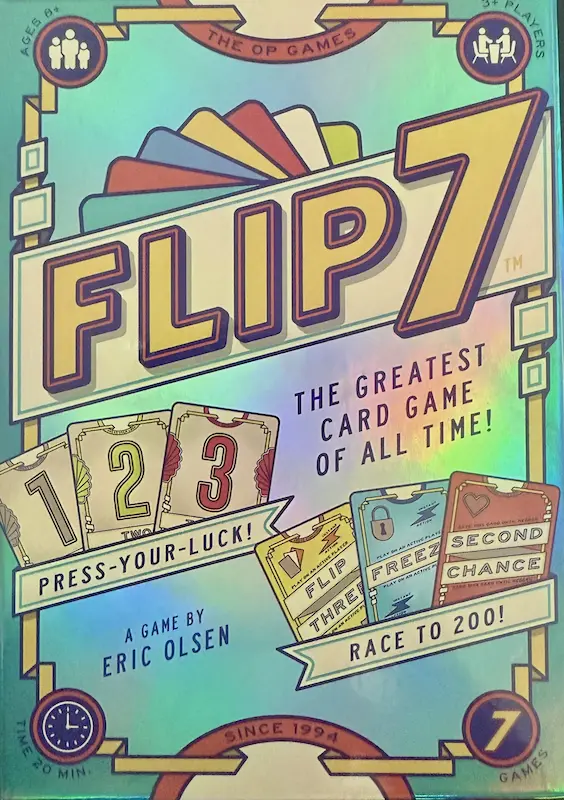
Age Rating: 6+ Players 2-6. Time: 15-30 minutes. Type Card: Luck with Strategy
This is a fast paced card game which is easy to learn, easy to take away for holidays or store and engaging with a fun twist of a bit of strategy. To win, be the first to score 200 points.
How to Play Flip 7
Shuffle the deck, and one play is the dealer. Place one card face up to each player, and if an action card is placed, solve that action card immediately. On your turn, you choose to hit or stay. Hit = Deal 1 card, Stay = Score your cards from the ones in front of you. If you get a repeated number card, you are immediately busted and out of that round and score zero. If you get seven unique cards in front of you, you get 15 extra points, and that round is finished.
If you are dealt a modifier card, place it above a card, and you add those points to your point total. If you are dealt an action card, you can choose any person to complete this (including yourself). A freeze card means you bank your points and you are done for that round, while a Flip 3 means you are dealt 3 cards. Second chance, you save for later. Use this if you are dealt a second card of the same value, so you don’t go bust. Add your points for each round, and then the player to the left of the dealer becomes the new dealer, and you continue until the first person reaches 200 points.
Great game for helping with math calculations, and if math isn’t your thing, just grab a calculator.
Age Rating: 8+. Players 2-4. Time: 30-45 minutes. Type Strategy + tile placement
We’ve found this to be a fantastic game to play over and over again. My favorite part is the modular board, which means the forest looks different every single time you play. It grows as you go!
Why It’s a Family Favorite
Grows with Your Kids: It features both a “Standard” and an “Advanced” side, so once we mastered the basics, we had a whole new challenge waiting for us.
Cooperate or Compete: I love that we can choose to work together to build the forest or play more competitively to see who can gather the most treasures.
The Goal: You’re trying to create mushroom circles on the forest floor to collect mushrooms, flowers, and hidden treasures.
How to Play: 3 Simple Steps
When it’s your turn, you simply draw a tile and follow these three steps:
1. Place Your Tiles
Examine the garden and pick up two tiles.
Connect the Paths: You must place them next to the central stump or other tiles already in the garden.
Pro Tip: All sides must match up! If a path doesn’t connect quite right, I just flip the tile over to find a better fit.
2. Complete a Circle
Check if you’ve completed a ring of white dotted mushrooms.
If you have, add a mushroom token and count your tiles!
Move your marker on your player board to claim your rewards.
3. Move Your Gnome
You can choose to move your gnome or skip this step.
I usually place my gnome on a path that isn’t occupied yet. Why? Because if anyone (including your opponents!) completes that circle, you get to harvest the mushrooms from it!

Age Rating 16+. Players 3-6. Time 20-30 minutes. Type Music Trivia
If your family loves music as much as mine does, Hitster is a total blast. It’s a trivia game that tests how well you know hits from the last several decades. It’s less about “who is the singer” and more about “when did this song come out?”
⚠️ Note: Before you start, you’ll need to download both the Hitster app and Spotify on your phone to play the music.
The Goal
The aim is simple: be the first to get 10 song cards in the correct chronological order in your personal timeline.
How To Play Hitster
You can play individually or divide into teams (which I recommend if you have kids playing with adults!).
1. Set Your Starting Point
Each player or team starts with one card.
Flip it over to see the year—this is the “anchor” for your timeline.
2. Scan and Listen
Draw a new card and scan the QR code using the Hitster app.
A song will automatically start playing on Spotify. Now the fun begins!
3. Place Your Card
You don’t have to guess the exact year (though it’s cool if you do!). You just have to decide: did this song come out before or after the cards already in your timeline?
Once you decide, place it in the spot you think is right.
4. The “Challenge” (Our Favorite Part!)
If you think your opponent placed their card in the wrong year, you can “challenge” them by placing a token.
Flip the card over to reveal the truth! If you were right and they were wrong, you could steal the lead.
Age Rating 13+. Players 2-6. Time 60-90 minutes. Type Cooperative
Chronicles of Light: Darkness Falls Overview
This is a cooperative team game where you work together to protect the Realm of Light. You win by completing three specific goals: finishing every hero’s personal quest, defeating all shadow creatures, and destroying the central vortex.
Setting Up the Board
Create the board by shuffling the Realm of Light tiles and Crystal Castles.
Connect the tiles one by one, ensuring all edges match (land to land, water to water).
Place your hero movers at Crystal Castle.
Mix the shadow tokens and place them on their designated board spaces.
Preparing Your Team
Your team features Hero Belle, Maid Marian, Belle, and Violet.
Place the team health token on the action board according to the number of players.
Shuffle the Crystal Darkness cards for your specific heroes.
Draw the number of cards required for your player count.
Starting the Quests
Each player randomly chooses a quest card and follows its specific setup.
Assign a team leader.
Draw the top Darkness card and follow the instructions to place the vortex and an additional shadow token.
Decide whether you will play using the beginner or advanced rules.
Gameplay and Victory
The round ends once the team has completed 6 actions.
Quests can be tackled one at a time or simultaneously as a group.
To secure a win, you must complete all hero quests, clear the shadow creatures, and destroy the vortex before your health or time runs out.
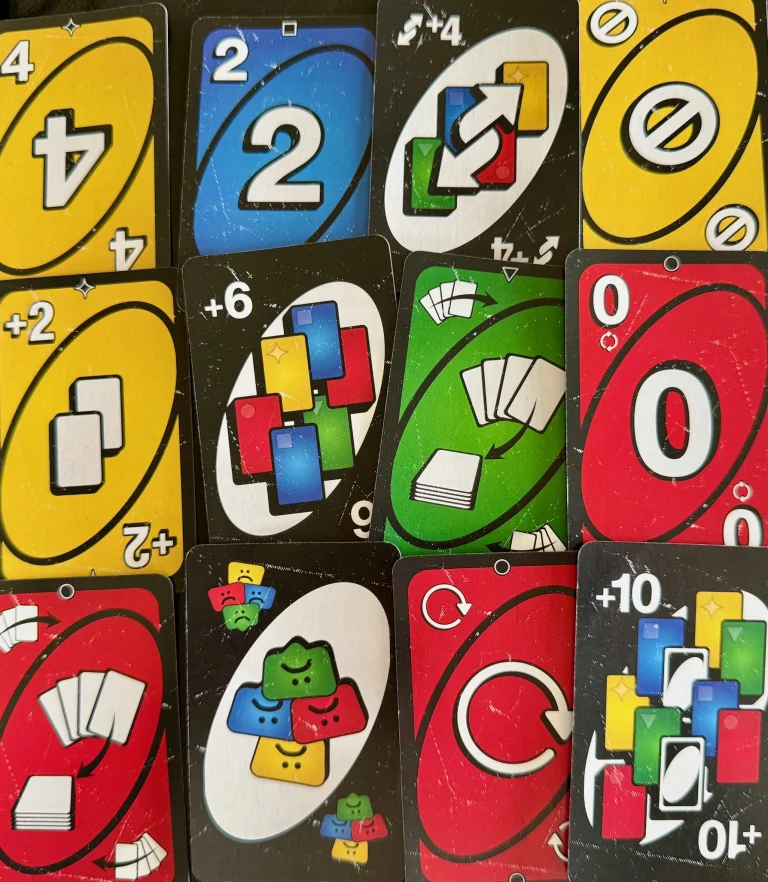
UNO Show ‘em No Mercy Overview
If you thought regular UNO was competitive, get ready for a version that is truly ruthless. Mattel has added 56 extra cards and a set of “Mercy” rules that can knock players out of the game entirely. I found this version much faster and more intense than the original and at times more frustrating.
What Makes This Version Different
The core game is still the UNO you know, but with much tougher action cards and a “stacking” mechanic that can lead to massive card hauls.
The Mercy Rule
If you ever have 25 or more cards in your hand, you are immediately out of the game.
The New Action Cards
Wild Draw 6 & Wild Draw 10: These can ruin an opponent’s hand instantly.
Skip Everyone: You get to take another turn immediately.
Discard All: Play this to get rid of every card in your hand that matches that color.
Key Strategy Rules
The Stacking Rule: You can pass a penalty (like a Draw +2 or +10) to the next player if you have a matching card. This continues until someone can’t play, and that person must draw the total combined sum of all the cards!
The “7” Swap: When you play a 7, you must swap your entire hand with another player of your choice.
The “0” Rotate: When a 0 is played, every single player must pass their hand to the person next to them in the direction of play.
How to Win
The goal remains the same: be the first player to get rid of all your cards. Just don’t forget to shout “UNO!” when you are down to your final card, or you might find yourself drawing a lot more than you bargained for!
Age Rating: 6+. Players 1-4. Time: 10–25 minutes. Type STEM + Card
Description
SNAP 2 IT is a stem board game where players embark on a race to be first to light up the game. Players draw 3 cards from the deck to start.
You place one card down and snap into place the piece shown on the card placed.
While planning your victory, you also want to try and sabotage opponents play.
Players can strategically leverage the snap wire, or wild, skip any player or next player misses a turn card at the perfect time to be the first to light their lamp and win.
You can also check out the game and short video here.
Eplore More Amazing Family Games Here
- Best Family Games
- Best 3 Player Games
- Travel Games
- Or explore the classic board games, which are still well loved by families.