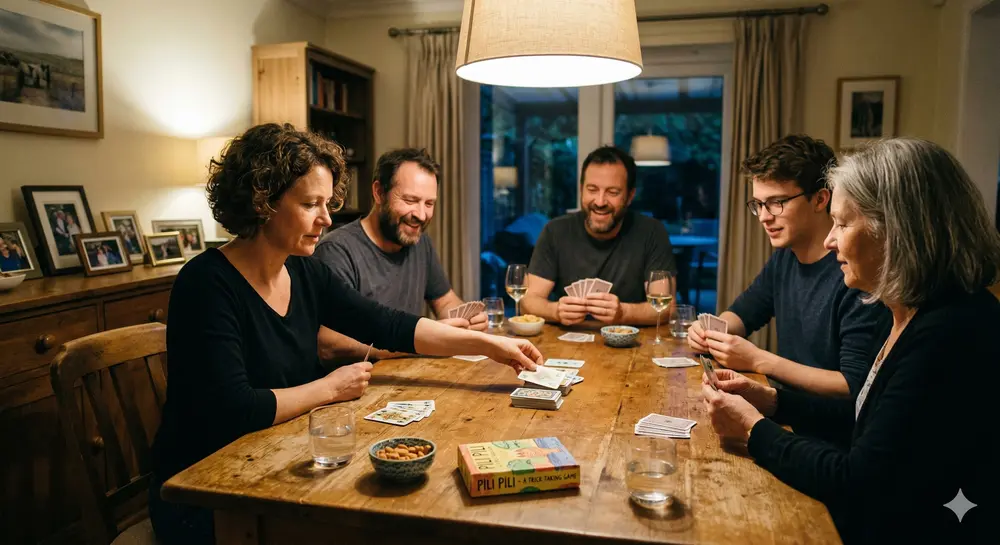
Simple Concept, But Fun to Master - Trick-Taking Card Games
I personally love a good trick-taking card games. I enjoy the strategic thinking of how and when to play your cards and what your opponents might have. If you too are a seasoned card shark or a family looking for a new game night staple, trick-taking card games are currently experiencing a massive tabletop renaissance. While the genre is rooted in centuries-old traditions, modern designers have "mutated" the classic mechanics to include everything from space exploration to quantum physics.
In this guide, I’ve found the best trick-taking card games to hit the shelves recently, along with a few "modern classics" that every family should own.
I am an Amazon Affiliate, and if you click a link, I may earn a commission. At not extra cost to you.
What is a Trick-Taking Card Game?
At its core, a trick-taking game involves players playing one card from their hand per round (the "trick"). Usually, the highest card or a specific trump suit wins the pile. However, modern titles often add a twist: you might be trying to avoid winning tricks, bidding on exactly how many you’ll take, or even working cooperatively to meet a shared goal.

The Crew: Mission Deep Sea
- Stats: Ages 10+ | 2–5 Players | 20 Min
- Game Type: Cooperative game
- Objective: Work as a team to complete a series of specific underwater “missions” without failing a single task.
- How to Play: It follows standard trick-taking rules (follow suit if you can), but communication is limited.
- Each player is assigned specific tasks (e.g., “Win a trick with a value of 5”). If anyone accidentally wins a trick they weren’t supposed to, the whole team loses.
- You will place a token on a card as a means to communicate what you hold. Place the token on the bottom of the card to show this is the highest number I hold inthin this color.
- Watch How To Play The Crew in 3 Minutes Here
I enjoy the deep-sea theme, as it is engaging, and love how everyone works toward a common goal, it really builds a sense of teamwork within your family/group.
The mechanics are simple to learn but offer a lot of strategic depth, making it accessible for both new and experienced players. I especially like the replay value; with different missions and difficulty levels, the game stays fresh even after several playthroughs.
If you enjoy games where communication and collaboration are key, this is a great one to add to your collection.

Cat In The Box: Deluxe Edition
- Stats: Ages 10+ | 2–5 Players | 30 Min
- Objective: Score points by accurately bidding on how many tricks you’ll win while avoiding a “paradox.”
- Brief Overview This is a “quantum” game where cards have no color until played.
- When you play a card, you declare its color and place a token on a central research board.
- You cannot claim a number/color combination that has already been taken. If you run out of legal moves, you cause a paradox and lose points.
- Watch the How to Play Video – A few people stated a viideo is best to understand the rules.
This is a nice blend of trick-taking with hand management, forcing you to win tricks while carefully avoiding a paradox.
I recommend it because you have to constantly pay attention to everyone else’s moves to keep your own options open.
Unlike traditional trick taking games that can become predictable once you’ve deduced the other hands, this stays interactive and full of table chatter since you never truly know what a card is until it’s played.
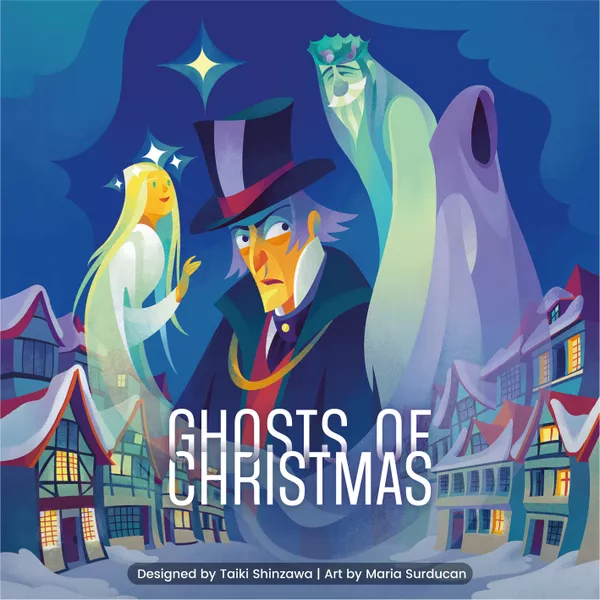
Ghosts of Christmas
- Stats: Ages 10+ | 3–4 Players | 40 Min
- Objective: Win exactly the number of tricks you bid on by manipulating three different timelines.
- Overview of Play: You play cards into the Past, Present, and Future simultaneously.
- The trick is resolved chronologically: the winner of the “Past” becomes the lead for the “Present,” which determines the winner of the “Future.” It’s a brain-bending tactical challenge.
- Bonus: Also small enough to fit as Christmas stocking stuffer.
- Watch How to Play Here.
The “three-era” mechanic adds a creative strategy that I haven’t found in traditional trick-taking games. Winning a hand in the Past allows me to lead in the Present, creating unique tactical opportunities where I have to track two different leads at once.
I find the bidding phase critical; while standard strategies like suit-voiding still apply, I have to be much more forward-thinking here.
Even when I’m dealt a weak hand, the game stays engaging because I can pivot to a low-bid strategy and try to catch up later with a bolder play. It’s a great pick for anyone wanting a multifaceted and tactical twist on the genre.

Sea Change
- Stats: Ages 8+ | 1–8 Players | 30–40 Min
- Objective: Earn the most points by winning tricks with positive point cards and avoiding “sea trash” (negative points).
- Overview of Play: The first card played sets the trump suit. However, any player can trigger a “Sea Change” by playing a card of the same value as the previous one, which immediately shifts the trump to that new suit.
- You can grab this from Walmart for around $10 if your in the USA
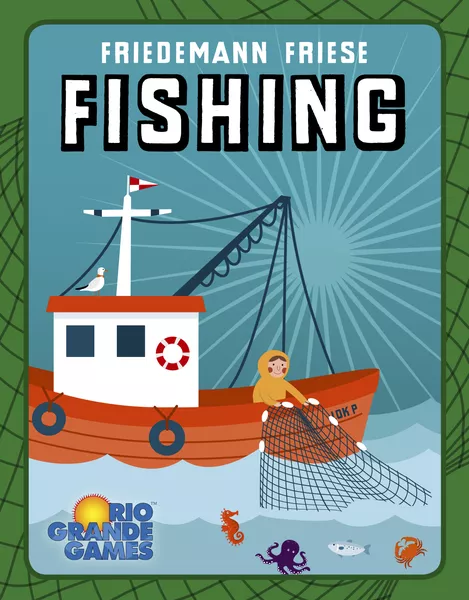
Fishing (Fischen)
- Stats: Ages 14+ (easily 8 to 10 plus)
- Number of Players: 3–5 Game Time: 30–45 Min
- Objective: Accumulate the most points over 8 rounds of play.
How to Play: Fishing
1. Setup & Starting the Game
- Player Boards: Each player takes a Fisher card (for tricks caught this round) and a Boat card (for your draw stack).
- The Ocean Stack: Sort cards by stars (0–5). Layer them facedown with 5-star cards at the bottom, graduating to 1-star cards on top.
- Starting Hands:
- 3 Players: 10 cards each.
- 4 Players: 9 cards each.
- 5 Players: 8 cards each.
2. Round Basics: Trick-Taking Rules
- Follow Suit: The lead player plays any card. Others must follow that color if possible.
- Winning the Trick: The highest value of the led color wins.
- Trump Cards: Green cards are trumps. They always beat standard colors. If you can’t follow suit, you may play a trump.
- Collection: Place caught tricks facedown on your Fisher card. The winner starts the next trick.
3. Ending a Round & Scoring
- Points: At the end of the round, record 1 point for every card on your Fisher card.
- Restocking: Shuffle your caught cards and place them on your Boat (this is now your Stockroom).
- Note: In later rounds, always place “new” caught cards below any leftover cards in your Stockroom.
4. Preparing the Next Round (Rounds 2–8)
- Draw Your Hand: Check the round card to see how many cards you need. Draw them from your Stockroom first.
- Refilling from the Ocean: If your Stockroom is empty and you still need cards, draw the remainder from the Ocean Stack.
- Tip: The player needing the most cards draws first—this is how you get higher-value cards and trumps!
- Who Starts? The player with the fewest total points leads the first trick of the new round.
5. Special “Buoy” Cards
As the Ocean Stack thins, you’ll encounter cards with unique abilities:
- The “0” Cards: Let you “steal” one card from the trick before the winner takes the rest.
- Buoys: Can be played even if you can follow suit. They can change the rules for the next trick (e.g., “Lowest value wins” or “Call the color”).
- Negative Points: Watch out for the -3 point cards! They count as a regular card for your hand later, but hurt your score immediately when caught.
- Watch: Here is a thorough video on How to Play Fishing
- I enjoy Fishing, as with each new round the game introduces new and more powerful cards to mix up play. Super fun. Just like Spades but with a fun twist.
- NOTE: It does say for ages 14+, but if your child grasps trick-taking games, I honestly think an 8-10-year-old is fine.
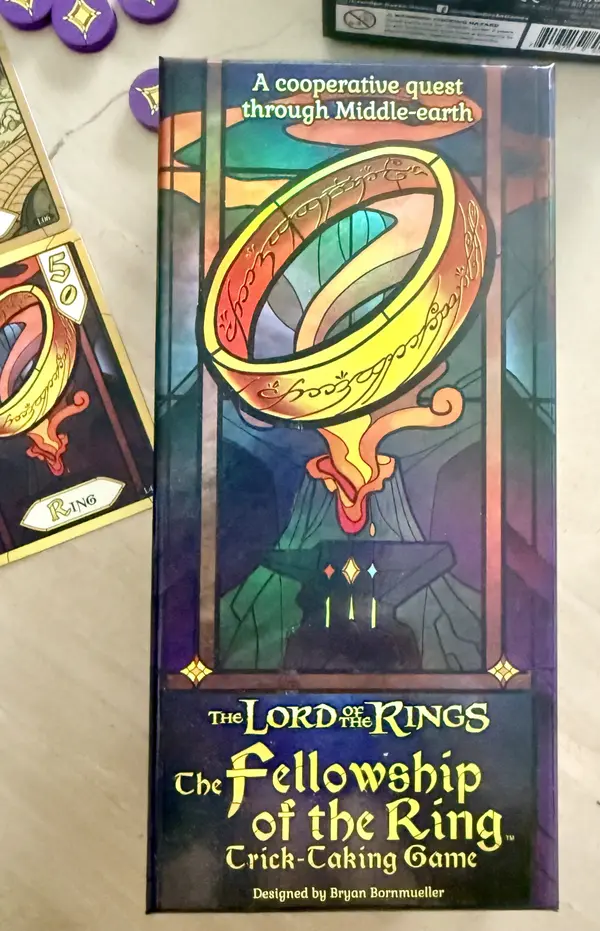
The Lord of the Rings: Fellowship of the Ring
- Stats: Ages 10+ | 1–4 Players | 20 Min
- Game Type: Cooperative Card Game
- Objective: Complete 18 narrative chapters by meeting specific trick-taking goals for each character.
How to Play: The Fellowship of the Ring Trick-Taking Game
1. Game Setup
- Chapter Card: Select your current chapter, place it in the center, and read it aloud.
- Character Selection:
- Characters marked with a star (*) on the chapter card must be played.
- The player dealt the 1 Ring card must take the Frodo character card.
- Other players choose their characters clockwise from Frodo.
- The Lost Card: Shuffle the deck and place one card face down next to the chapter card. This card is “lost” for the round (if it’s a Ring, reshuffle it and draw again).
- Dealing:
- 2–3 Players: 12 cards each.
- 4 Players: 9 cards each.
- Setup Actions: Check your character card for a hammer icon. Perform this action (e.g., swapping cards or revealing your hand) before the round begins.
2. Core Trick-Taking Rules
- Leading: Frodo starts the first trick by playing any card.
- Following Suit: Players must play a card of the same suit (Forest, Mountain, Hill, or Shadow) if they have one. If not, they may play any card.
- Winning a Trick: The highest card of the led suit wins the trick. The winner takes the cards and leads the next trick.
- Communication: You may discuss your character goals, but you cannot show your hand or discuss card preferences during character selection.
3. The Ring Suit & The One Ring
- Leading Rings: You cannot lead a trick with a Ring card until a Ring has been “broken” (played into a previous trick). Flip the Ring Token to its colored side to track this.
- The 1 Ring: This is the most powerful card. It can win any trick, even if it doesn’t match the led suit.
- The Choice: The player who plays the 1 Ring chooses whether to win the trick automatically or treat it as a “1” (the lowest value), allowing someone else to win.
- Rings 2–5: These act like normal cards and only win if they are the highest rank of the led suit.
4. Winning and Losing
- Fulfilling Goals: When you complete your character’s specific objective, place a star token on your card.
- Ending the Round: The round ends when all cards have been played.
- Victory: You win the chapter only if everyone completes their character goal.
- Defeat: If even one player fails their goal, the entire group loses and must restart the chapter.
- Tip: There are special rules for 1 or 2 players, and my first 2-player game was a bit hard to grasp, so I suggest playing with 3 players first to understand the basic concept of the rules. This video does explain how to play.
- NOTE: This is a cooperative trick taking game.
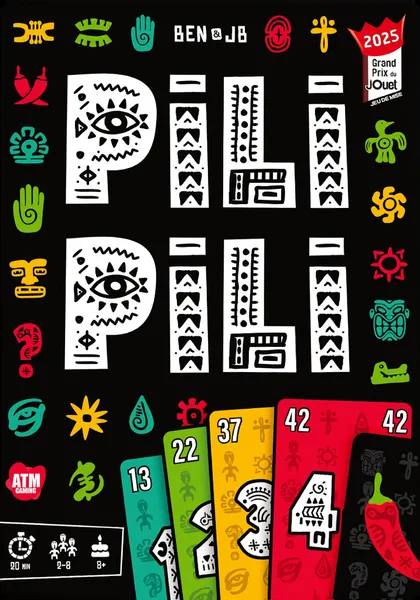
Pili Pili
- Stats: Ages 8+ | 2–6 Players | 20 Min
- Objective: Be the player with the fewest “Pili” (penalty) tokens by successfully meeting your bids.
How to Play Pili Pili:
PILI PILI is a dynamic trick-taking game where the goal is to predict your success exactly. Unlike most games, you want to avoid collecting “Pili” penalty tokens; the player with the fewest penalties wins.
1. Betting Phase
Once the cards are dealt, assess your hand and predict exactly how many tricks you will win.
Simultaneous Reveal: All players reveal their bets at the same time (using fingers or tokens).
The Goal: You are aiming for a perfect match. Any deviation—higher or lower—will result in penalties.
2. Trick-Taking Phase
The player to the left of the dealer leads the first card.
Follow Suit: You must play a card of the same suit as the lead card if you have one. If you are out of that suit, you may play any other card.
Winning the Trick: The highest card of the lead suit wins the trick.
The Joker: These are powerful cards that typically win the trick unless a special rule says otherwise.
Mission Cards: Each round features a unique mission that changes the rules. These can alter card interactions, how tricks are won, or how scoring works for that specific round.
3. Scoring & Pili Tokens
After all cards are played, compare your actual tricks won to your initial bet.
Successful Bet: If you hit your number exactly, you receive 0 penalties.
Unsuccessful Bet: You receive Pili penalty tokens equal to the difference between your bet and your actual wins.
Example: If you bet 2 but win 4, you get 2 Pili tokens.
Example: If you bet 2 but win 0, you get 2 Pili tokens.
4. Game End
The game ends the moment any player accumulates 7 Pili penalty tokens.
Winning: At that exact moment, the player with the fewest Pili tokens is the winner.
My take:I love how every turn begins with a new mission card, forcing you to pivot each round based on that card. For example, play highest or lowest, or if you win a trick with certain numbers, you get an extra Pili.
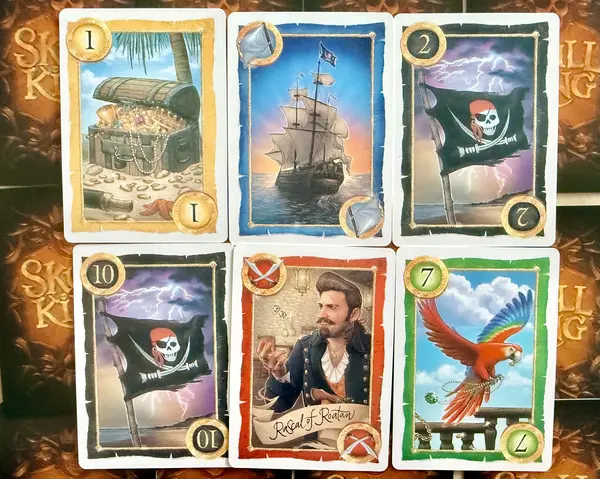
Skull King
- Stats: Ages 8+ | 2–8 Players | 30–45 Min
- Publisher: Grandpa Becks Games
- Objective: Predict exactly how many tricks you will win each round to score points.
How to Play Skull King
1. The Bidding
After cards are dealt, players study their hands and bid simultaneously:
- The Ritual: Everyone puts a fist on the table. On the count of three, everyone chants “Yo-Ho-Ho!” and extends fingers to show their bid (or a fist for zero).
- Zero Bids: Highly rewarding but risky. If you bid zero and win zero, you get big points. If you win even one trick, you lose points.
2. Trick-Taking Rules
- Following Suit: If a colored suit (Parrot, Chest, or Map) is led, you must follow that suit if you can.
- Trumps: The Black (Jolly Roger) suit is the permanent trump. It beats any of the other three colored suits, regardless of number.
- Special Cards: These can be played at any time, even if you can follow the led suit.
3. Card Hierarchy (Who Wins the Trick?)
- The Mermaid: Beats the Skull King and all numbered cards. Loses to Pirates.
- The Skull King: Beats all numbered cards and all Pirates. Loses only to the Mermaid.
- Pirates: Beat all numbered cards (including Black trumps).
- Tigress: You must declare if she is a Pirate or an Escape when played.
- Jolly Roger (Black): Beats the three standard colored suits.
- Standard Suits: Highest number of the led suit wins.
- Escape: Always loses. Use these to avoid winning a trick you didn’t bid for.
Special Interaction: If a Pirate, the Skull King, and a Mermaid are all in the same trick, the Mermaid always wins.
4. Scoring
Points are only awarded if you hit your bid exactly.
| Result | One or More Bid | Zero Bid |
| Exact Match | +20 pts per trick won | +10 pts × Current Round Number |
| Missed Bid | -10 pts for every trick you are off | -10 pts × Current Round Number |
5. Bonus Points
- You only collect these bonuses if you make your bid:
- Capturing a 14: +10 pts (+20 if it’s the Black 14).
- Pirate captures Mermaid: +20 pts.
- Skull King captures Pirate: +30 pts.
- Mermaid captures Skull King: +40 pts.
6. Winning the Game
- The player with the highest total score after 10 rounds is the winner. If there’s a tie, play one more sudden-death round!
- Watch How to Play Skull King Here

Vivo
- Stats: Ages 10+ | 3–4 Players | 20–30 Min
- Objective: Score points by playing the highest or lowest “on-harmony” cards.
How to Play Vivo
This trick-taking game centers on balancing high-rank wins with low-rank scoring. I find it unique because you aren’t just trying to win the trick; you’re trying to decide which type of points you want to walk away with.
1. Game Setup
The Harmony Card: Shuffle the Harmony Cards and place one faceup in the center of the table. This card dictates the “rule” for the current round.
The Deal: Each player receives a hand of 12 Playing Cards.
2. Playing a Trick
Leading: The lead player can play any card from their hand to start the trick. They are not restricted by the current Harmony Card.
Following the Harmony: Every player after the leader must “Follow the Harmony” if possible. This means you must play a card that satisfies the specific suit requirements shown on the center card.
3. Scoring the Trick
Once everyone has played a card, the players who successfully stayed “on-harmony” are eligible for points.
Highest On-Harmony Rank: You score your card facedown. This is worth a flat 2 points.
Lowest On-Harmony Rank: You score your card faceup. Your points are equal to the rank of the card itself.
Off-Harmony: If you couldn’t follow the Harmony Card, you cannot score for that trick.
Trick-Taking Card Games Conclusion
What does it mean to “follow suit”? Following suit is a core mechanic where players must play a card of the same suit as the lead card. If you cannot follow suit, you may usually play a “trump” card or “slough” a card from a different suit.
Are there cooperative trick-taking card games? Absolutely. Games like The Crew: Mission Deep Sea and The Fellowship of the Ring: Trick-Taking Card Game have revolutionized the genre by requiring players to work together toward a shared goal rather than competing.
Keep Exploring:
- Easy Card Games for Families
- Strategy Games – for the whole family or one of my favourites Dragonwood
- Best Family Games
- Best 5 Player Card Games – No Long Waits
- Games for 3 Players
- Tiny games
- Fast Paced Card Games
- Numba – Educational Maths Games