
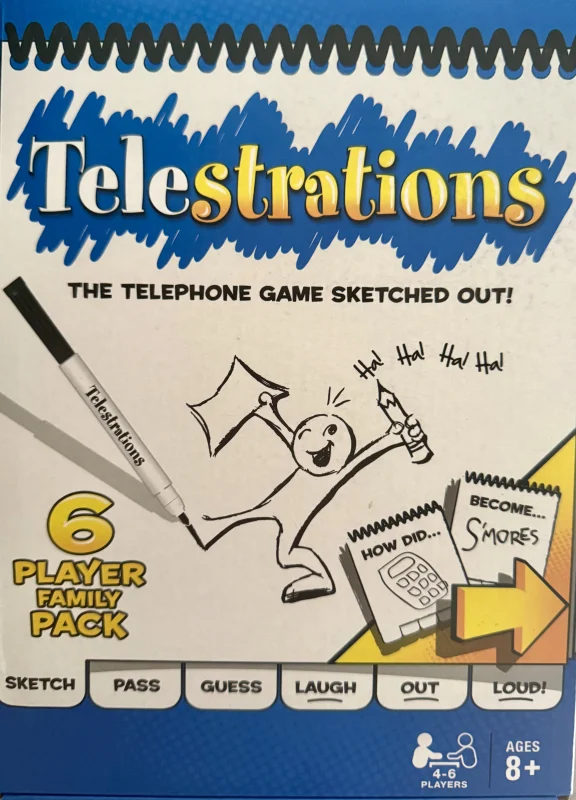
How to Play Telestrations : The Ultimate Guide to the Party Game Phenomenon
How to play Telestrations, the fun, hilarious, ultimate icebreaker or a surefire way to bring hilarious chaos to your next game night. Often described as a mix between the classic game of “Telephone” and “Pictionary,” this award-winning party game is famous for turning simple prompts into laugh-out-loud misunderstandings.
Whether you are unboxing a classic edition or diving into the newest version, this step-by-step guide will teach you how to play Telestrations, understand the rules, and master both casual and competitive scoring.
How to Play Telestrations - Setting Up
Getting ready to play is quick and easy. Follow these steps to set the table before the laughter begins:
Centre the Cards: Place the card box in the middle of the playing area where everyone can reach it.
Grab Your Gear: Give every player one dry-erase sketchbook and one marker.
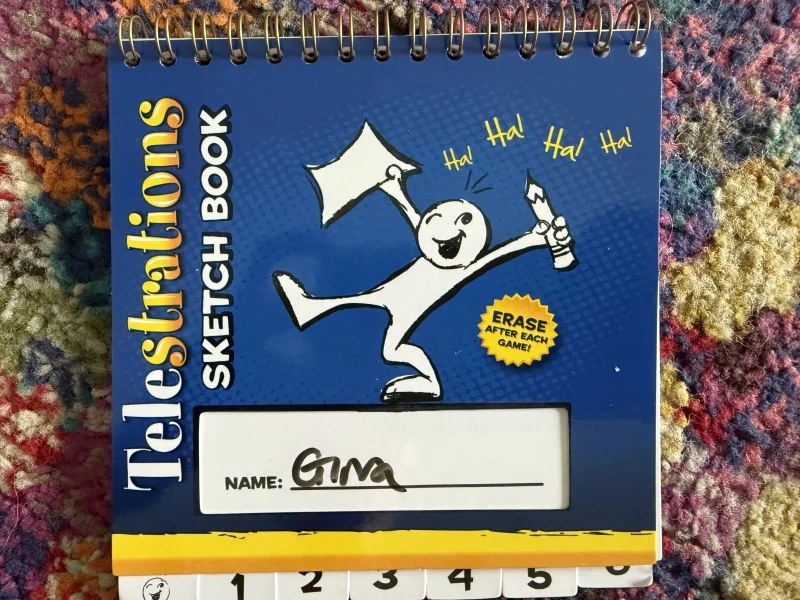
Claim Your Book: Write your name in the dedicated space on the front cover of your sketchbook.
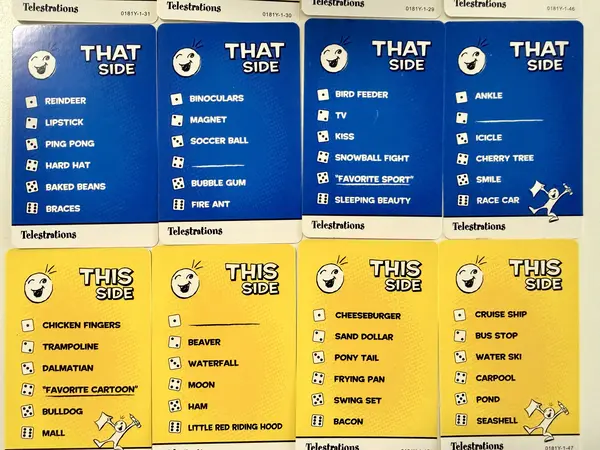
Draw a Card: Each player randomly draws one prompt card from the card box.
How you choose your word depends entirely on the version of Telestrations you own:
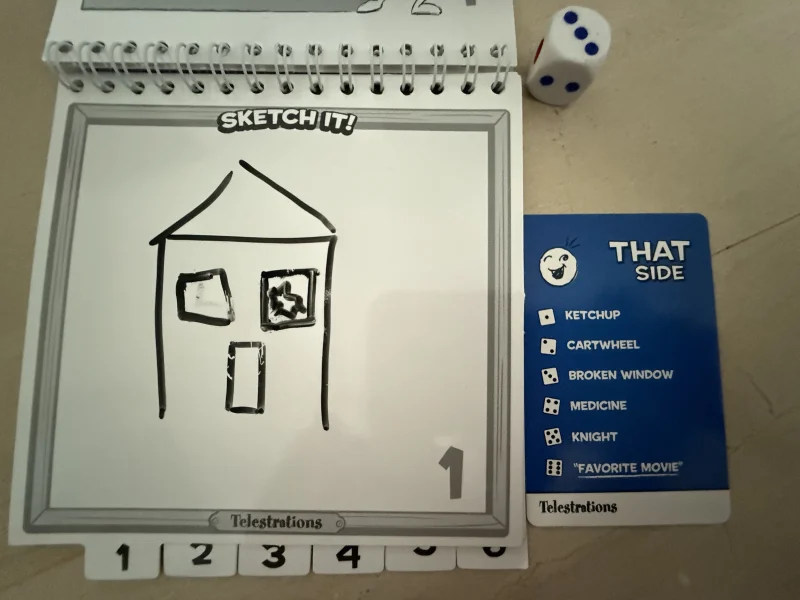
The Die Roll: Roll the six-sided die. Look at your card and find the prompt that matches the number rolled. For example, if you roll a 3, and the prompt is “Broken Window”, that is your secret word.
Once you have your word, flip to the front page of your booklet and write it down secretly in the “Secret Word” section. Keep it hidden from your competitors.
Step 2: How to Play Telestrations (Gameplay)
Before you begin, have everyone check the number of people playing, as it changes your very first move:
The Odd/Even Player Rule:
Odd Number of Players (3, 5, 7): Immediately pass your sketchbook to the player on your left. They will draw your secret word.
Even Number of Players (4, 6, 8): Keep your own sketchbook. You will be the first one to draw your own secret word.
Round 1: Sketch It
Turn your sketchbook to page one, labeled “Sketch It”. Flip the 60-second timer. Every player now has one minute to quickly draw their secret prompt as best as they can.
The Golden Rule: You cannot use any letters or numbers in your drawing (be flexible if you have young children, though).
Don’t panic: Even if you think you are a terrible artist, draw something. Bad drawings actually make the game much funnier.
Example: A player looks at the secret word "Broken Window"
and draws a cracked window of a house
Round 2: Guess It
Once the timer runs out, turn the booklet to the next page to hide your artwork, and pass the sketchbook to the player on your left.
Everyone will now look at the drawing the previous player made. Flip to the next page, labeled “Guess It”, and write down what you think that drawing is supposed to be.
You must write a guess, even if you have absolutely no idea what the artwork is.
Once written, turn the page to hide your guess and pass the booklet to the left.
Continuing the Cycle
The game continues in this exact pattern—alternating between drawing what you read, and guessing what you see.
The round concludes when you receive your original sketchbook back. Every sketchbook should naturally end on a final written guess.
Step 3: The Big Reveal & Scoring
If you are playing a casual game, you don’t even need to keep track of points! Simply take turns flipping through your original sketchbooks out loud so everyone can see the hilarious evolution of how “Broken Window” somehow turned into a “Fried Egg”.
However, if your group is feeling ambitious, you can play a structured three-round game using one of two scoring methods. Record your points on the front of your sketchbook after each round. The player with the highest score wins!
Option A: Friendly Scoring (For Casual Fun)
Favorite Sketch (1 Point): Look through your returned booklet and pick your favorite drawing. The artist who drew it gets 1 point.
Favorite Guess (1 Point): Pick your favorite guess from your booklet. The person who wrote it gets 1 point.
Perfect Match (1 Point): If the final guess in your book matches your original secret word, you score 1 point.
Option B: Competitive Scoring (For Serious Gamers)
Accurate Guessers (1 Point): Earn 1 point if your guess matches the original secret word or matches the guess right before you.
Helpful Artists (1 Point): Earn 1 point if your drawing successfully helped the next player guess the correct word.
Sequence Success (1 Point): The owner of the sketchbook gets 1 point if the last guess matches the original prompt.
Telestrations Review
I’ve found this to be incredibly easy to learn and teach people. You can play for as long or as short as you like.
I can quite easily laugh at myself and my inability to draw objects. I also love seeing what others are trying to interpret what they drawing. I’ve also found the discussion after with my kids about their drawings really fascinates me. I am like, ‘Oh yea, I can see why you did that now.’
The space and books are a good size and easy to use. The ring binders worked well, as did the marker pens.
Frequently Asked Questions
Telestrations
Can you play Telestrations with 3 players?
While the box specifies 4–8 players, you can play with 3 players using the odd-player rules variant.
However, I’ve found that the passing of sketchbooks is short; the words rarely morph into the funny misunderstandings that make the game famous. It is highly recommended to play with at least 4 people.
What is the difference between Telestrations and Pictionary?
In Pictionary, teams compete against a clock to guess a single drawing made by one person. In Telestrations, everyone plays simultaneously, individual drawings are secret, and the game plays like a visual game of “Telephone” where the prompt changes with every single player.
Can you use letters or words in Telestrations?
No, you cannot use letters, numbers, or words in your drawings. Your clues must be entirely visual.
Symbols like arrows, question marks, or thought bubbles are generally allowed unless your group decides to ban them beforehand.
Make your own house rules, if you have young children. If they are finding it hard let them use symbols or numbers or maybe even broader terms like writing a country, if they are really struggling. Find a way to get them participating.
Game time is about connection, not being strict on the rules, so it excludes people.
Other Recommendations
- Word games for families
- Drawing games
- Party games
- Herd Mentality – Think like the Udders and guess a word as an answer
- Flip 7 – a fun, easy to learn push your luck card game
- Or check out the best family games for 2026