
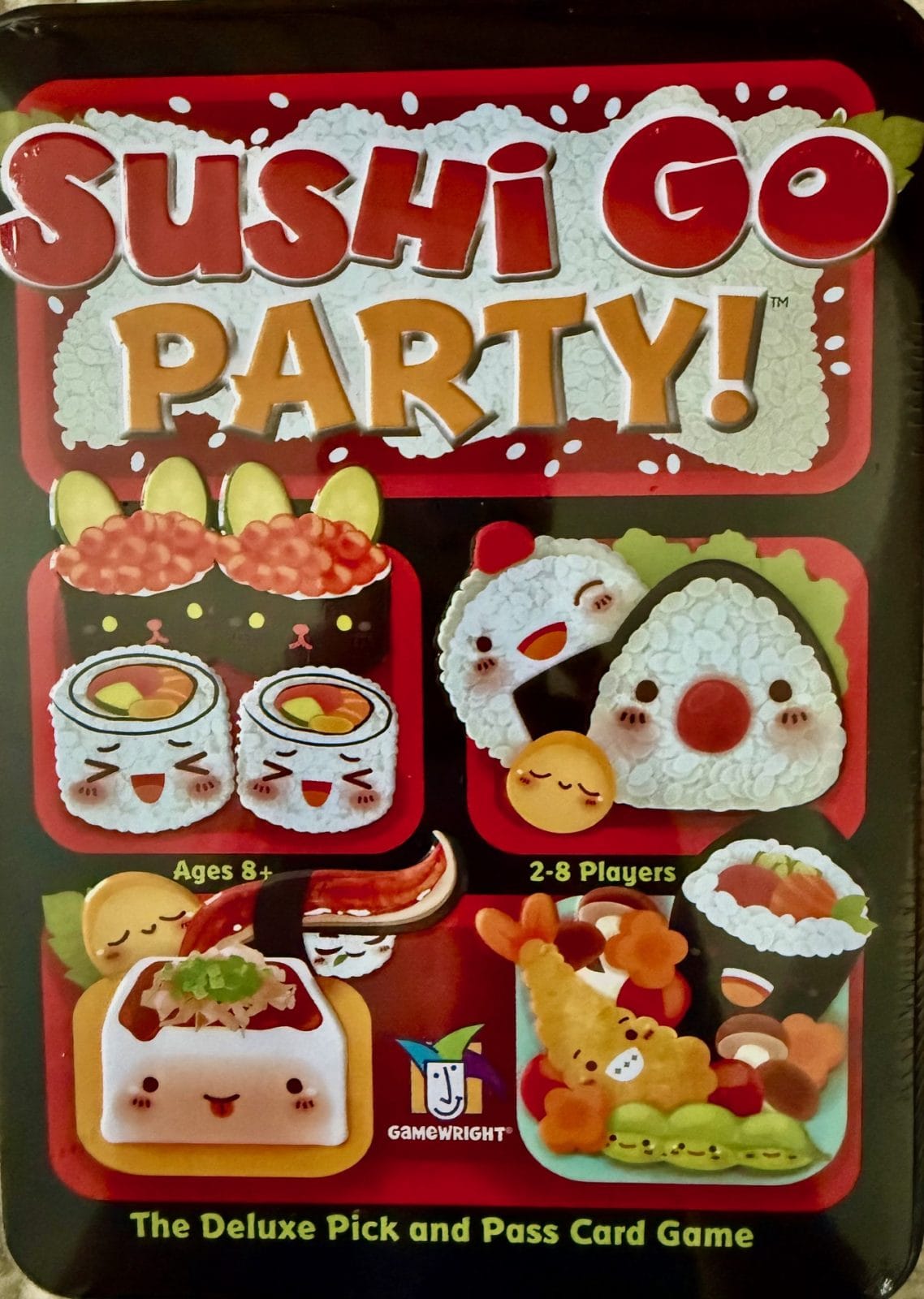
About Sushi Go Party
If you’re looking for a light-hearted yet strategic fun card game to play, Gamewright’s, Sushi Go Party is a great choice. This delightful game is a fun card game for family game nights or casual get-togethers with friends. In this detailed guide, we’ll cover everything you need to know about Sushi Go Party, from the rules to pros and cons.
I am an Amazon Affiliate and may earn a small commission if you click a link—at no extra cost to you.
Sushi Go Party: The Ultimate Card Drafting Game
This is a must-have if you enjoy light strategy games that keep everyone engaged at the same time. As a bigger, better version of the original Sushi Go card game, this box offers endless variety by letting you customize your “menu” for every match.
Players: 2–8 (Great for large families!)
Age Rating: 8+
Game Time: 20–30 minutes
Game Type: Card Drafting / Set Collection
In my experience, Sushi Go Party! is the ultimate version of the classic Sushi Go card game. Designed by Phil Walker-Harding, this expanded edition takes the beloved “pick and pass” mechanic and turns it into a customizable feast. It is a fantastic set collection game that perfectly balances light strategy with a bit of luck, making it a staple for our family game nights.
Why I Love This Version
One of the best things about this version is the variety. While the original game is great, the “Party” edition allows you to swap out different menu items every time you play. The cute artwork and fast-paced nature make it an attractive option for gamers of all skill levels.
The Objective
The goal is simple: I want to create the most valuable meal possible! You earn points by selecting and passing sushi cards over three rounds. The player with the highest total score at the end of the third round is crowned the winner.
Setting Up the Feast
I usually spend a few minutes getting the “menu” ready before we dive in. Here is how I set it up:
The Board & Pawns: Place the game board in the center and have everyone choose a pawn. We place these on the “0” space to track our scores.
Card Selection: This is the best part! Collectively, we decide which cards to use. If it’s your first time, I recommend the “My First Meal” or “Party Sampler” presets.
The Menu Tiles: Once we’ve picked our cards, I slide the corresponding menu tiles into the board slots. This lets everyone easily see which combinations are in play and how they score.
The Decks: I shuffle the chosen dessert cards and place them facedown. Then, I shuffle the rest of the chosen cards to form the main draw pile.
Mixing in Desserts: Depending on the player count, I mix a specific number of dessert cards into the main deck for each of the three rounds.
How to Play Sushi Go Party!
This is a simultaneous play game, which means there is no waiting around for someone else to finish their turn!
The Deal: If we have 2–5 players, I deal 10 cards to each person.
Pick and Pass: Everyone looks at their hand, picks one card they want to keep, and places it facedown.
The Reveal: Once everyone is ready, we flip our chosen cards over at the same time. Then, we pass the remaining cards in our hands to the player on our left.
Special Actions: If I play a “Special” card (like Chopsticks), I make sure to call out the action before picking up my new hand. Chopsticks are great because they allow me to take two cards on a future turn!
Handling Desserts: If I pick a dessert card, I place it to the side. These aren’t scored until the very end of the third round.
Scoring: After all cards are played, we move our pawns along the board based on the points we earned that round.
After three rounds of drafting and scoring, we add up our final dessert points. In my house, the person with the most pudding usually has a huge advantage!
Pros and Cons: Is Sushi Go Party! Right for You?
I love a game that can get everyone to the table without a thirty-minute rules explanation. Here is my honest breakdown of what makes this one a winner and a few things to keep in mind.
The Pros
Easy to Learn: The rules are incredibly simple. It is one of the best card games for families because even new players can jump in and start scoring immediately.
High Replayability: Because you can customize the menu, no two sessions feel the same. This is my favorite feature—it prevents the game from ever feeling “solved” or stale.
Fast-Paced Sessions: Most games wrap up in about 20–30 minutes. It’s the perfect length for a quick weeknight match or a “warm-up” game for a longer night.
Great for All Ages: With an age rating of 8+, it really is a cross-generational hit. I enjoy seeing kids beat the adults by focusing on a simple “Dumpling” strategy!
Visually Appealing: The artwork is just plain adorable. The cute sushi theme makes it very approachable for people who might be intimidated by more “serious” strategic titles.
The Cons
The Luck Factor: Like many great card games, there is an element of luck in what you are dealt. While I think this keeps things exciting, it can be a little frustrating if you are one card away from a big “Sashimi” set and it never comes around!
Scalability Speeds: While it officially supports up to 8 players, the game can slow down if you have one or two “over-thinkers” at the table. I can be an impatient person sometimes, so I find the game shines best with 3 to 5 players where the rotation is snappy.
Final Thoughts
Sushi Go Party! is a fantastic choice that perfectly blends simple mechanics with strategic depth. Its customizable nature keeps the experience fresh, and the fun theme makes it a delightful experience for players of all ages.
Perfect for a casual gamer or a board game enthusiast, this is a must-have if you want to add a light and fun option to your collection. It has definitely earned its permanent spot on my shelf.
Other card games that might interest you: The Mind is a cooperative card game, or read about the best card games for families.
Sushi Go designer, Phil Walker-Harding also developed Planted, which you can check out here.