


Best 10 Minute Board Games for Quick Connection
10 Minute Board Games Selection
These 10 minute board games are the perfect screen-free family activities to help you bond without the stress of a long setup or a two-hour commitment.
With the rush of school runs, dinner prep, and bedtime routines, finding an hour for a board game often feels impossible. However, you don’t need a whole afternoon to reconnect with your kids. In 2026, the trend is moving toward “micro-connections”—short, high-impact bursts of play that fit into the cracks of a busy day.
I am an Amazon Affiliate; if you click a link, I may earn a commission. At no extra cost to you. These recommendations are my own choice from experience and research.
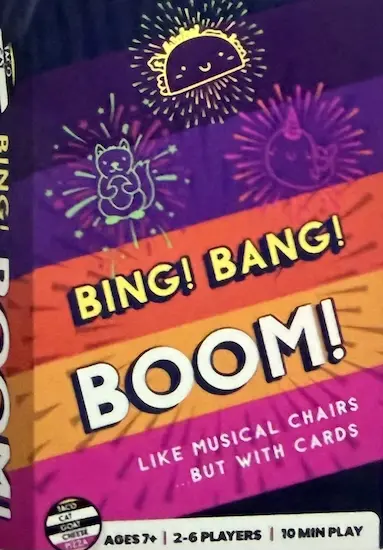
Bing! Bang! Boom!
A high-energy “fireworks” themed race from the creators of Taco Cat Goat Cheese Pizza.
- Game Type: Speed / Reaction Card Game
- Age Rating: 5+
- Number of Players: 2–6
- Objective: Be the player with the fewest “Duds” at the end of the game by being the fastest to match cards.
- How to Play: One player flips a card onto the “Start” pad. Everyone races to find a matching card in their hand to play on the “Bing,” then “Bang,” then “Boom” pads while shouting the words. The last player with a matching card gets stuck with a “Dud.”
- Games Like: Taco Cat Goat Cheese Pizza, Slap It!.
- FAQ: Is it too loud for quiet nights? Yes, this is a loud, shouting game. It’s better for high-energy afternoons than a calm wind-down. But its a great way to release built up feelings.

Don’t Bee Last
A “brain-blending” party game that tests your reflexes and pattern recognition.
- Game Type: Reaction / Pattern Recognition
- Age Rating: 8+ (7+ for original version)
- Number of Players: 2–6
- Objective: Avoid being the last person to slap the card pile or the player who collects the most cards.
- How to Play: Players take turns placing cards and shouting out the correct color, pattern, or fruit. If the card shows a Bee, everyone must slap the pile—the last person to do so loses the round and takes the cards.
- Games Like: Ghost Blitz, Anomia Kids.
- FAQ: What happens if I misspeak? If you hesitate or say the wrong color/fruit, you have to take the entire pile of cards on the table.
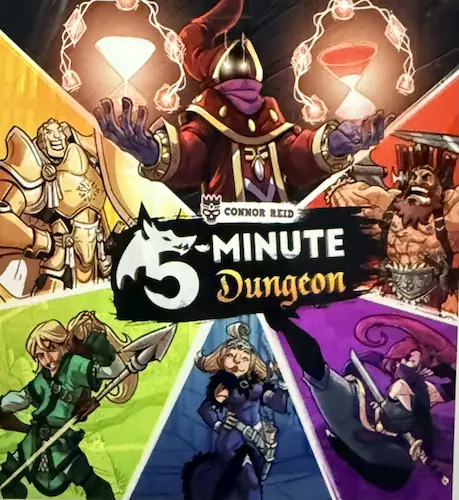
5 Minute Dungeon
The ultimate high-speed cooperative game where you win or lose as a team.
- Game Type: Real-time Cooperative Card Game
- Age Rating: 8+
- Number of Players: 2–5
- Objective: Work together to defeat all the monsters and the Dungeon Boss before the 5-minute timer runs out.
- How to Play: There are no turns. Everyone plays cards from their hand simultaneously to match the symbols on the current dungeon door. Once matched, flip the next card and keep going until the Boss is defeated.
- Games Like: 5 Minute Mystery, Magic Maze.
- FAQ: Can we pause the timer? Only if a player uses a specific “Stop Time” ability card. Otherwise, the clock never stops.
Spot It! (Dobble)
A modern classic that relies on one simple rule: there is always one matching symbol.
- Game Type: Visual Perception
- Age Rating: 6+
- Number of Players: 2–8
- Objective: Be the fastest to spot the one matching symbol between two cards.
- How to Play: In the most popular version, “The Tower,” each player has one card, and a pile sits in the middle. Find the match between your card and the center, shout it out, and take the card. The person with the most cards wins.
- Games Like: Blink, Set.
- FAQ: Are there different ways to play? Yes, the rulebook includes 5 different “mini-games” using the same deck of cards.
Couch Kittens
A cozy, quick-hitting card game specifically designed for smaller groups.
- Game Type: 2-Player Strategy / Set Collection
- Age Rating: 9+
- Number of Players: 2
- Objective: Be the first player to fill the “couch seats” with your kittens by placing them according to their numbers.
- How to Play: Players take turns placing kitten cards on the couch. You must manage your hand and place numbers strategically to block your opponent and secure your spots first.
- Games Like: Exploding Kittens (15 mins), Shotten Totten (20 minutes)
- FAQ: Can more than two people play? The base game is strictly a two-player game, making it a perfect “date night” or “one-on-one” game for a parent and child.

Gap
The Colorful Strategy of “Minding the Gap”
- Publisher: Arcane Wonders / Funbot
- Designers: Rico Besteher and Frank Noack
- Game Time: 10 Minutes
- Number of Players: 2–6 Players
- Age Rating: 8+
- Game Type: Card Drafting / Set Collection
- Objective: Collect cards of different colors to create the largest “gap” between the color you have the most of and the color you have the least of.
- Gameplay Overview: In Gap, players play a card from their hand to the center. If the number matches any cards in the middle, you take them all. If there are no matches, you take the cards with adjacent numbers (e.g., play a 7, take 6 and 8). The twist? You score points based on the quantity of your most frequent color minus the quantity of your least frequent color. It is a clever, fast-paced puzzle where you have to balance taking cards you want with avoiding cards that will ruin your score.
🛒 Buy on Amazon: – A brilliant, colorful “filler” game that fits in a pocket. It’s simple enough for an 8-year-old but provides a satisfying strategic “crunch” for parents.
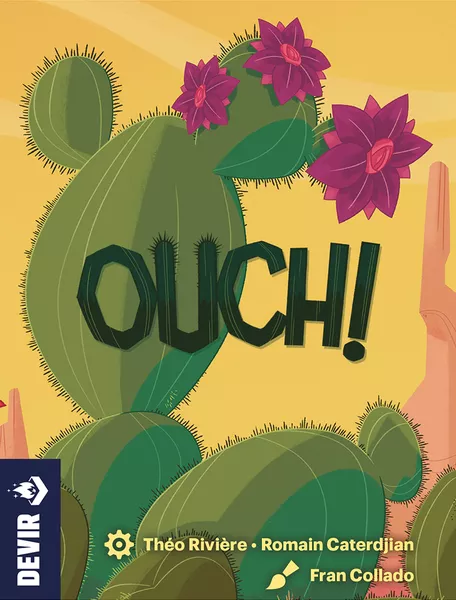
Ouch!
The High-Stakes Cactus Plucking Game
- Publisher: Devir Games / Thames & Kosmos
- Designers: Romain Caterdjian and Théo Rivière
- Game Time: 10 Minutes
- Number of Players: 2–5 Players
- Age Rating: 5+
- Game Type: Push Your Luck / Memory
- Objective: Gather the most cactus flowers without getting “pricked” by the thorns on the back of the cards.
- Gameplay Overview: Six cactus cards are laid out showing only their “flower” side.
- On your turn, you choose a card and announce which side you are going to grab (top, bottom, left, or right) before flipping it. If the side you touched has thorns—Ouch!—you lose the card.
- If it’s clear, you keep it. Some cards have animals with special powers, and red flowers offer bonus points but are much riskier.
- It is a high-energy, “laugh-out-loud” game that kids absolutely adore.
🛒 Buy on Amazon: – The ultimate travel game for younger kids. It’s portable, fast, and replaces the “boredom” of waiting with the “tension” of not getting pricked!
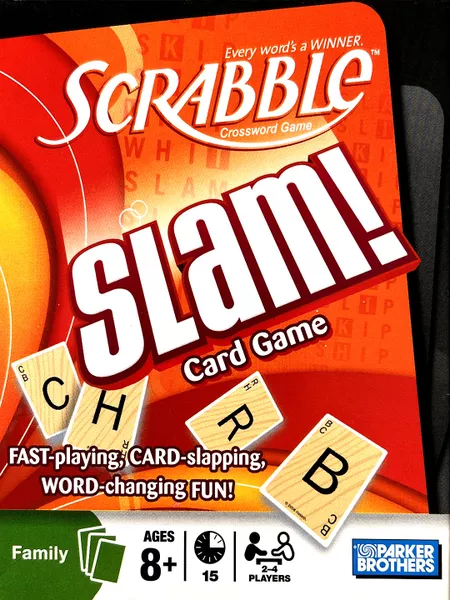
Scrabble Slam
The High-Speed Word Race
- Publisher: Winning Moves / Hasbro
- Designers: Joe Abrams
- Game Time: 10 Minutes
- Number of Players: 2–4 Players
- Age Rating: 8+
- Game Type: Real-Time Word Building
- Objective: Be the first player to get rid of all your cards by changing a four-letter word on the table.
- Gameplay Overview: There are no turns in Scrabble Slam. A four-letter word (like “CAKE”) is placed in the center.
- Everyone “slams” their letter cards down simultaneously to change the word (e.g., someone drops a ‘B’ over the ‘C’ to make “BAKE,” then someone else drops an ‘I’ over the ‘A’ to make “BIKE”).
- It’s a frantic, fast-thinking race. Because it’s real-time, the game usually ends in under 5 minutes, making it the fastest word game on the market.
🛒 Buy on Amazon: – Forget the slow pace of traditional Scrabble. This is a high-speed adrenaline rush that helps kids with spelling and quick thinking without them even realizing they’re learning.
FAQ's
Couch Kittens: Gameplay FAQs
- Q: Can I place any kitten on any couch space?
- A: No. Kittens must be placed according to their specific number and position rules. You are essentially “claiming” a spot on the couch, and if your opponent has a higher-numbered kitten, they might be able to “bump” yours off.
- Q: What happens if I can’t play any of the cards in my hand?
- A: If you have no legal moves, you must discard your hand and draw new cards, effectively ending your turn. This is a critical moment for resilience, as it can feel like a big setback, but because the game is only 10 minutes, you can usually pivot quickly.
- Q: Does the “Messy Dog” card remove my kittens or my opponent’s?
- A: Depending on the version you are playing, “Dog” or “Action” cards usually act as a reset for a specific couch space. They are designed to “clear the seat,” allowing either player to try and reclaim it on their next turn.
- Q: Is it purely luck, or is there strategy involved?
- A: While there is card-draw luck, the strategy lies in hand management. You have to decide whether to play your low-numbered kittens early to fill space or save your “Big Cats” (high numbers) to protect your spots or steal your opponent’s seats at the end.
- Q: We both ran out of cards and the couch isn’t full. Who wins?
- A: If the deck and hands are empty and the couch isn’t fully claimed, the player who has the most kittens currently on the couch is declared the winner
Don’t Bee Last: Frequently Asked Questions
- Q: What happens if I slap the pile when there isn’t a Bee card?
- A: This is a “False Slap!” Just like misspeaking, if you slap the pile by mistake, you must collect all the cards currently on the table.
- Q: Is this game good for kids with ADHD?
- A: While it is high-energy, some parents find the constant switching between “word” and “color” can be a challenge for kids who struggle with impulse control. However, it’s a fantastic tool for practicing focus and resilience in short bursts.
- Q: Can you play Dont Bee Last with more than 6 people?
- A: The standard deck is best for 2–6 players.
- Q: Does the Bee card count as a turn?
- A: Yes. The player who flipped the Bee card has finished their turn once the “sting” (the slap) is resolved, and play moves to the next person.
- Q: What if we can’t tell who was last to slap?
- A: In a tie for “last place,” the person whose hand is on the very top of the stack is considered the slowest and takes the cards.
General Gameplay & Strategy FAQs 5 Minute Dungeon
- Q: Can we take back cards if someone else plays a “Slay” card first?
- A: No. The official rule is “a card laid is a card played”. If you play resources to match a monster and another player simultaneously plays an action card to instantly defeat it, your resource cards are wasted and swept away into the discard pile.
- Q: Can we talk while the timer is paused?
- A: Yes! Using a “Pause” ability (like the Wizard’s Stop Time) is the only time you should stop to strategize. You can even use other character abilities while the time is paused without restarting the clock, but each player can only use their ability once per pause.
- Q: What happens if we run out of cards in 5 Minute Dungeon?
- A: If a player runs out of cards in both their hand and draw pile, they are “out” of the action until another player uses a card like Heal, Donation, or Confusion to give them cards or bring them back from the discard pile. If everyone runs out of cards, the team loses immediately.
- Q: Can I use my special ability to defeat a Boss?
- A: Generally, no. Special abilities that defeat a specific type (Monster, Obstacle, or Person) do not work on Bosses or Mini-Bosses.You must match the symbols on the Boss Mat or use special cards like the HolyHand Grenade that specifically mention they work on Bosses.
- Q: How do we set up for only 2 players?
- A: In a 2-player game, each player should select two hero decks and shuffle them together into one large draw pile. This ensures you have enough resources to get through the larger dungeons without running out of cards too early.
- Q: Do you have to discard exactly 3 cards for an ability in 5 Minute Dungeon?
- A: Yes. To activate your hero’s special ability, you must discard exactly 3 cards from your hand to your personal discard pile. If you have fewer than 3 cards, you cannot use your ability until you draw more.
Spot It! (Dobble) FAQs
- Q: Is there really a match on every single card in Spot It?
- A: Yes! The game is built using a mathematical principle called a “Finite Projective Plane.” Because of this, any two cards in the deck will always have exactly one—and only one—matching symbol.
- Q: What if we both shout the matching symbol at the exact same time?
- A: In the case of a tie, the player who physically takes, places, or discards their card first is the winner of that round.
- Q: My child says they can’t find a match. Are there “dud” cards?
- A: It does seem that way sometimes, but there are no duds. If a player is stumped, it’s usually because the symbols are different sizes or rotated at different angles. I’ve found a great tip for social-emotional learning is to have everyone pause for 5 seconds to help the struggling player find their match before moving on.
- Q: Is Spot It ok with a 4-year-old and a 10-year-old?
- A: Yes, but the 10-year-old will likely have faster reflexes. We’ve found to level the playing field, give the younger child a 2-second “head start” to look at the cards before the older child are allowed to shout. Doesnt always work, because of course the 10-year-old is keen to win, but give it a try.
Couch Kittens: Gameplay FAQs
- Q: Can I place any kitten on any couch space?
- A: No. Kittens must be placed according to their specific number and position rules. You are essentially “claiming” a spot on the couch, and if your opponent has a higher-numbered kitten, they might be able to “bump” yours off!
- Q: What happens if I can’t play any of the cards in my hand in Couch Kittens?
- A: If you have no legal moves, you must discard your hand and draw new cards, effectively ending your turn. This is a critical moment for resilience, as it can feel like a big setback, but because the game is only 10 minutes, you can usually pivot quickly.
- Q: Does the “Messy Dog” card remove my kittens or my opponent’s?
- A: Depending on the version you are playing, “Dog” or “Action” cards usually act as a reset for a specific couch space. They are designed to “clear the seat,” allowing either player to try and reclaim it on their next turn.
- Q: Is it purely luck, or is there strategy involved?
- A: While there is card-draw luck, the strategy lies in hand management. You have to decide whether to play your low-numbered kittens early to fill space or save your “Big Cats” (high numbers) to protect your spots or steal your opponent’s seats at the end.
- Q: We both ran out of cards and the couch isn’t full. Who wins?
- A: If the deck and hands are empty and the couch isn’t fully claimed, the player who has the most kittens currently on the couch is declared the winner.
Common Questions Parents Ask About 10 Minute Board Games
- Can 10 minute games actually teach anything? Absolutely. Short games are incredible for building resilience. Because the rounds are so fast, losing doesn’t feel like a disaster; it’s just an opportunity to try again immediately.
- Are these 10 minute board games travel-friendly? Most 10 minute games have a small footprint, making them the best “purse games” for waiting at restaurants or doctor appointments.
- How do I choose the right game for my family’s energy level? Ask yourself if you want “chaotic fun” (speed/slapping games) or “quiet strategy” (logic/deduction games). Matching the game to the current “vibe” of the house prevents mid-game meltdowns.
10 Minute Games can Still Build Connection and Resilience
When you choose 10-minute family games, you are teaching your children that play doesn’t have to be an “event”—it’s a lifestyle. These games are a wonderful venue for practicing social-emotional skills like taking turns and managing the “sting” of a loss in a low-stakes environment. They also provide a great way to reset the family some nights and reconnect as a family.
- Best Family Games
- Mindfulness Games
- Tacta Strategy Card Game – Learn in 30 seconds
- Dragonwood – Fab game for 8 year olds plus, even adults love this game
- Best Games for Shy or Introverted Kids
- Free downloadable games
- Board Games By Age