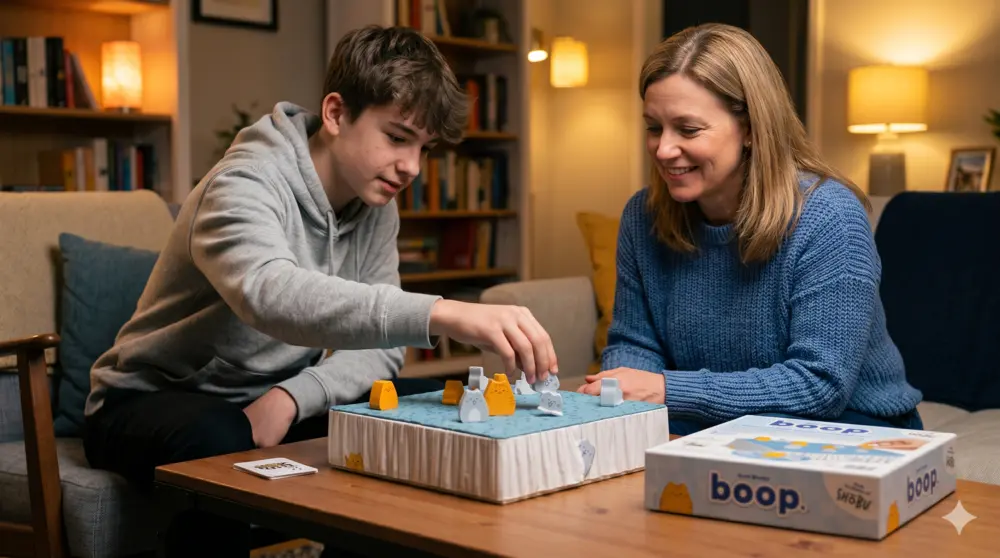
When it comes to finding the perfect way to spend quality time with a friend or a loved one, few activities beat the fun and challenge of 2 player board games.
This can be strategic battles, lighthearted competition, trick taking card games or testing your skills under pressure, there’s something special about 2 player board games. In this article, we explore some of the best 2 person board games, highlighting what makes them stand out and why they’re a must-try for board game enthusiasts.
I am an Amazon Affiliate and may earn a commision if you click a link. Thank you as this helps continue with purchasing games to review for our community.
Best 2-Player Board Games Overview

Spirits of the Wild: Awakening
This beautiful, tactile game about guiding woodland spirits is a delightful refresh of a classic. It’s a peaceful but competitive race focused on set collection and clever positioning.
- Players: 2
- Playtime: 20–30 Minutes
- Age: 10+
- Publisher: Mattel Games
- Game Type: Abstract Strategy / Set Collection
- Overview: Players compete to collect specific sets of colorful stones from a shared central bowl and place them onto their unique animal boards. Each animal scores differently based on the stone combinations they receive. The twist is the Coyote piece, which players can move to block their opponent from taking stones from specific sections of the bowl.
- Objective: Earn the most points by fulfilling the stone requirements of your animal boards before five clear spirit stones are drawn.
- How to Play: Play an Action Tile: On your turn, play one of your six face-up action tiles. Four are standard actions (e.g., “Add 2 stones to the bowl,” “Take 1 stone,” or “Move the Coyote”). Two are powerful, unique spirit animal abilities.
- Tile Placement: After using a tile, flip it face-down. It cannot be used again until you reset.
- Add/Collect Stones: Use actions to draw stones from a bag and add them to the central bowl, or take a stone from the bowl and place it on an animal board.
- The Coyote: Block your opponent by moving the Coyote to prevent them from taking stones from that section of the bowl.
- Reset Turn: You must occasionally spend an entire turn to “reset” all your face-down tiles, making them available again. When you reset, you also draw a powerful, one-time-use favor card.
- Clear Spirit Stones: These act as “wild” cards and can double an animal board’s score, but they also lock that board for the rest of the game.
Spirits of the Wild: Awakening, and it has quickly become my absolute favorite for date night. It’s a “chill,” 20-minute experience that looks stunning on the table and hits that perfect sweet spot between a simple card game and a big, complicated board game.
The artwork is truly gorgeous, and I love the tactile feel of the stones and the shared bowl—it makes the whole experience feel so special and high-quality. Best of all, I was able to learn the rules in about 3 minutes without needing to watch a single video.
Even though the energy is very calming and cozy, it’s a fun game of wits where I’m always trying to figure out my partner’s next move. If you want a quick, beautiful way to connect at the end of the day, this is a 5/5 star winner.
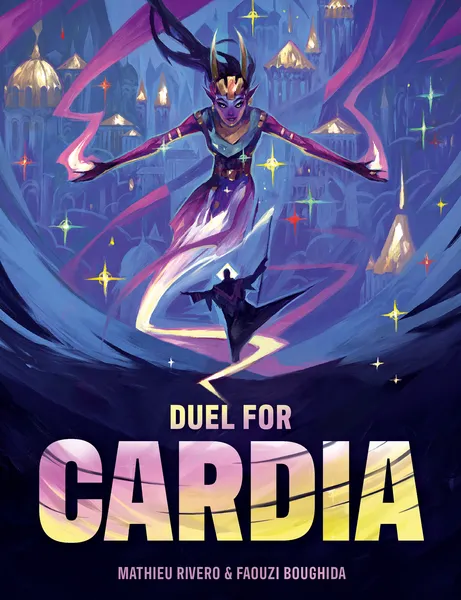
Duel for Cardia
Don’t be fooled by the fast playtime. This is a cutthroat, card-driven battle game of tactical head-to-head combat where players fight for control of a mystical, war-torn city.
- Players: 2
- Playtime: 15–20 Minutes
- Age: 10+
- Game Type: Simultaneous Play / Hand Management / Counter-Drafting
- Overview: Players control symmetric decks of cards numbered 1-16, with each number having a different special ability. Across multiple rounds, you will fight for control of key city locations by simultaneously revealing a single card. The high card wins the battle, but the low card triggers its powerful special ability.
- Objective: Be the first player to collect three of the four unique faction seal rings by winning battles in their associated city districts.
- How to Play: Card Draft: At the start of a round, players “counter-draft” five cards from their deck, keeping three and passing two to their opponent.
- Simultaneous Reveal: A battle for a location begins. Both players simultaneously choose and reveal one card from their hand.
- Win the Battle: The player with the highest card number wins the battle for that location.
- Trigger the Ability: The player who played the lowest card activates that card’s special ability (e.g., “Steal a previous battle win,” “Peek at your opponent’s hand,” or “Force them to play a specific card”).
- Win the Round: The player who wins the majority of battles in a district wins that faction’s unique seal ring. The tension is in balancing the desire for a high number (to win) with a low number (to unleash a powerful ability).
- Publisher: Asmodee
I found the learning curve remarkably short, yet mastering the mechanics requires skill. The experience thrives on the “mind games” it forces between two players. It is “thinky,” engaging, and consistently rewards those who pay attention to their opponent’s next move.
The components are beautiful, and given the affordable price point, the value here is unmatched. Plus, it is the perfect small game for travel.
If you are seeking a two-player experience that balances simplicity with tactical depth, this is a mandatory addition to your shelf.
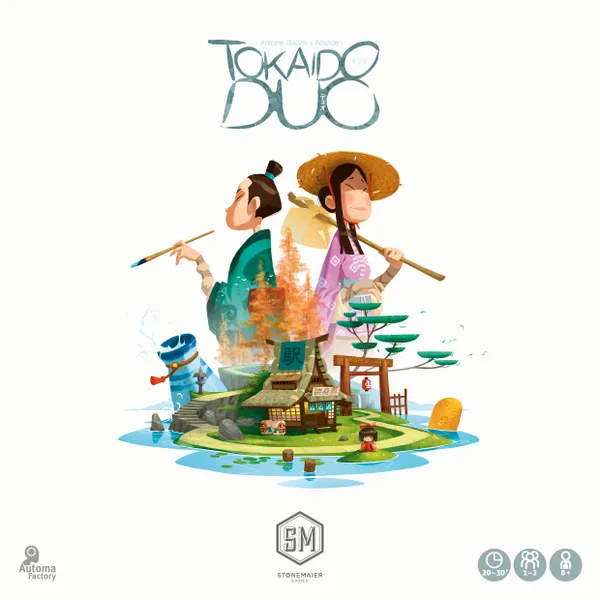
Tokaido Duo
Reimagining the serene journey of the original Tokaido as a dedicated two-player game, Tokaido Duo has players managing three separate characters to create the most rewarding pilgrimage.
- Players: 2
- Playtime: 20–30 Minutes
- Publisher: Funforge
- Age: 8+
- Game Type: Action Drafting / Grid Movement / Multiple Paths to Victory
- Overview: Instead of one traveler, you control a pilgrim, a merchant, and an artist, who each move and score in a unique way. On your turn, you are forced to make a clever choice from a shared “dice pool,” determining where all of your characters will move on their parallel journeys.
- Objective: Score the most combined points across your three character tracks before any single character finishes their journey.
- How to Play: A set of dice is rolled, representing available movement for the three characters.
- Draft Actions: Players take turns selecting one die from the pool.
- Move Characters: You must move the corresponding character (Pilgrim, Merchant, or Artist) the exact number of spaces shown on the die and immediately perform the action of the space you land on.
- Manage the Trio: To win, you must master all three character goals: The Pilgrim scores by visiting temples. The Merchant scores by buying souvenirs and selling them in other cities. The Artist scores by creating “paintings” and gifting them to local families.
- Block Your Opponent: Every action you draft is a constant tug-of-war. You must balance optimizing your own three paths with selecting a die simply to block your opponent’s planned move.
Tokaido Duo is a masterclass in elegant, two-player game design. While the atmosphere is relaxing, do not be fooled; managing three characters at once offers a genuine tactical challenge.
I find the dice-selection mechanic particularly impressive, as it forces meaningful choices and clever player blocking. It captures the beauty of the original game but stands on its own as a superior strategy title.

Endeavor Deep Sea
A major redesign of the classic game Endeavor: Age of Sail, Deep Sea swaps colonial trade for oceanic exploration. It’s a tight, rewarding engine-building experience that shines brightly with just two players.
- Players: 1–5 (Highly recommended at 2)
- Playtime: up to 30 Minutes
- Age: 12+
- Game Type: Engine Building / Action Drafting / Area Control
- Overview: You are the leader of a scientific expedition, assembling a team of experts and researching to unlock the secrets of the deep ocean. The core of the game is about recruiting new crew members. Each specialist you draft adds new “action engines” and ability tracks to your personal player mat.
- Objective: Build the most prestigious research team by scoring points across Influence, Crew, Research, and Conservation tracks.
- How to Play:Recruitment Phase: A game round begins with players drafting new crew members (e.g., Oceanographer, Dive Master, or Research Assistant) from a central market.
- Assemble the Engine: Add new crew members to your player mat to unlock new actions and ability tracks.
- Action Phase: Spend tokens to activate your crew’s “engines.”
- Perform Map Actions: Use your crew to explore new ocean zones (placing modular map tiles), move your ship, and send divers to collect scientific samples or finite “Impact Markers.”
- Research & Publish: Collect samples to fulfill research paper requirements, which provides points and tracks advancement.
- Tight Competition: Every map action is critical. Tiles have limited discovery bonuses, and impact markers are finite, creating fierce competition for space and resources on the map, making it a brilliant duel.
- Pros: Provides a deeply satisfying engine-building arc that works perfectly and competitively at the two-player count.
- Cons: With more interconnected systems, it is slightly more complex to learn and teach than other options on this list.
- Publisher: Burnt Island Games
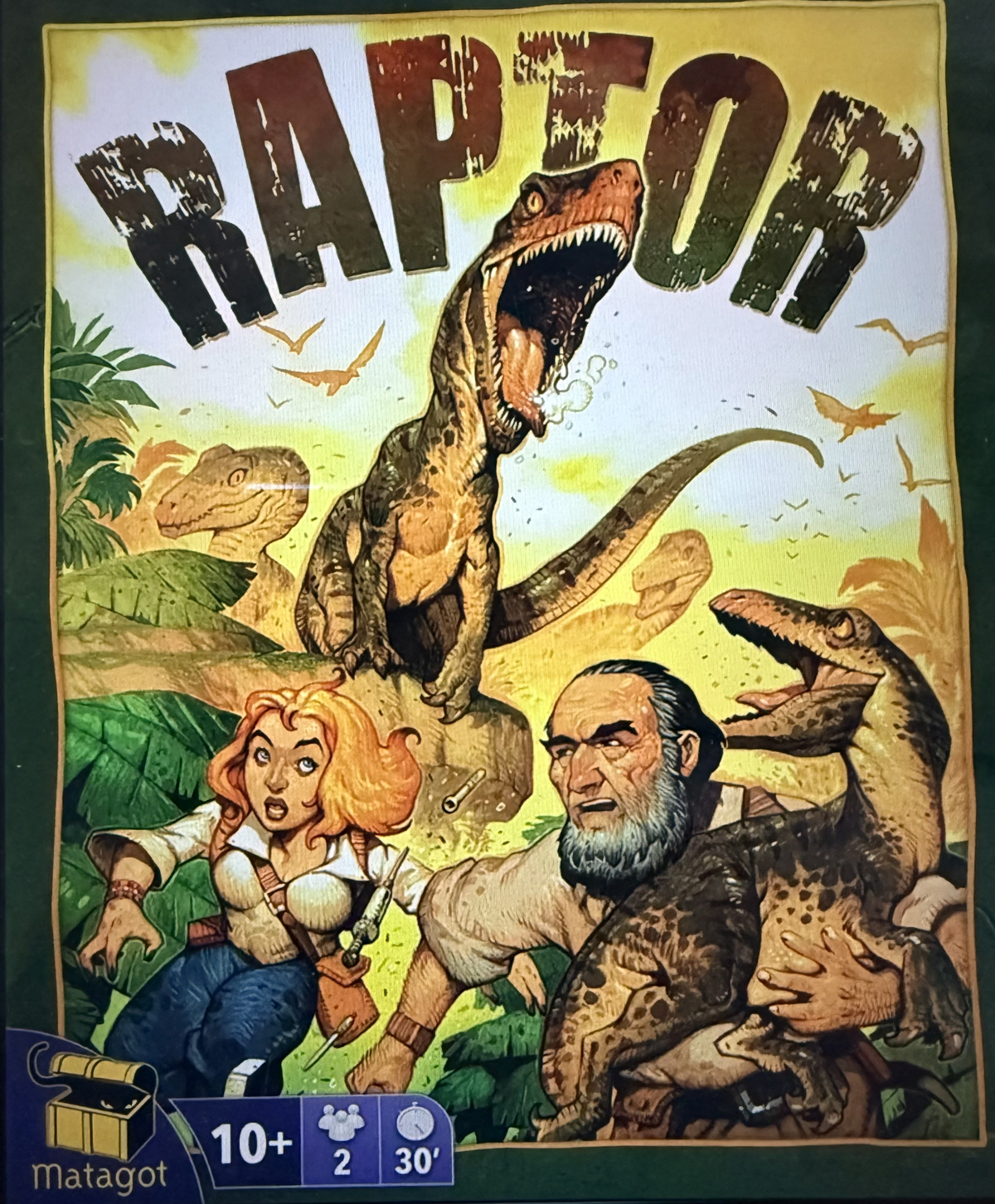
Raptor
- Age Rating: 9+ (some advise suitable for 8+)
- Players: 2 Players
- Game Time: 30 Minutes
- Game Style: Asymmetrical Strategy / Tactical Combat
- Objective: In this thrilling competitive 2 person game, one player acts as a Mother Raptor protecting her babies, while the other plays a team of Scientists trying to capture them. The Raptor wins by helping 3 babies escape or eating all scientists; the Scientist wins by capturing 3 babies or neutralizing the mother with sleep tokens.
How To Play Raptor: Core Movement Rules
- No Stacking: Only one figurine or token can occupy a space at a time.
- Orthogonal Only: Movement and shooting happen up, down, left, or right. Diagonal actions are never allowed.
- The Exits: Half-spaces are for baby raptors only. Scientists, the mother raptor, and fire tokens cannot enter these spaces.
The Game Round
Each round is played in three simple steps:
- Secret Selection: Both players choose one card from their hand and place it face-down.
- The Reveal: Flip the cards at the same time.
- Determine the Turn:
- If Values Match: Both cards are discarded. The round ends immediately with no actions taken.
- If Values Differ:
- Lowest Card: This player goes first. they apply the specific special effect written on their card.
- Highest Card: This player goes second. They do not use their card’s effect. Instead, they receive Action Points equal to the difference between the two cards.
- Example: You play a 2 and your opponent plays a 6.
- You go first and use your card’s special effect.
- Your opponent goes second and gets 4 Action Points (6 minus 2) to spend on their turn.
I like the detail on the miniatures—both the scientists and the raptors—is impressive, and the modular board ensures that no two sessions feel the same. While the rules are simple enough to master, there is a strategic depth that reveals itself the more I play.
I find the asymmetrical roles particularly engaging; playing as the scientists trying to capture the babies (not everyone likes this theme) feels completely different from playing as the mother raptor defending her brood.
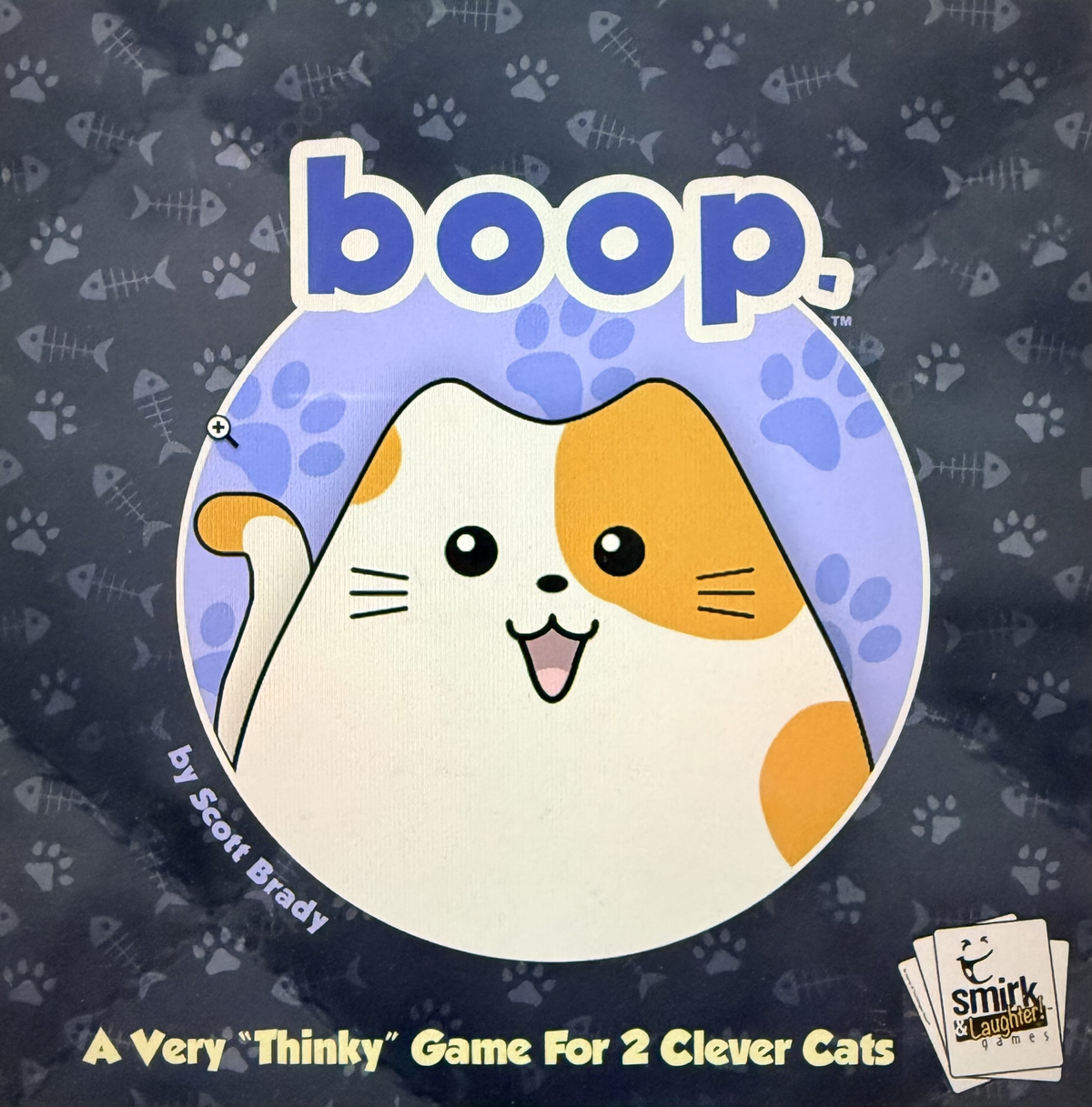
Boop
- Age Rating: 10+
- Players: 2 Players
- Game Time:
- 20–30 Minutes
- Game Style: Abstract Strategy / Positional Play
- Objective: A deceptively cute but brain-burning challenge. Players place kittens on a 5×5 bed, “booping” other cats away. Align three kittens to upgrade them to cats; align three cats to win. It’s one of the best tactical 2 player games for those who enjoy a “cat-and-mouse” mental battle.
How To Ploay Boop:
1. The “Boop” Mechanic
- Every time you place a piece (Kitten or Cat) on the 6×6 board, it “boops” every adjacent piece—including diagonal ones.
- The Push: Adjacent pieces are pushed one space away from the piece you just played.
- Falling Off: If a piece is pushed off the edge of the bed, it returns to that player’s pool.
- No Chain Reactions: A booped piece does not boop other pieces when it moves.
- The “Line of Two” Rule: A piece cannot boop two or more pieces that are already in a line. A solid line of pieces blocks the “boop.”
2. Graduating Kittens into Cats
You start the game with only Kittens. To get adult Cats, you must “graduate” them.
- Line up Three: If you line up three of your Kittens (horizontally, vertically, or diagonally), they are removed from the board and “graduate.”
- The Reserve: Place the three Kittens back in the box and take three adult Cats from your reserve into your pool.
- The 8-Piece Rule: If all 8 of your pieces are on the board and you haven’t lined up three, you may choose to graduate any one Kitten to get a Cat into your pool.
3. Kittens vs. Cats
Once you have Cats in your pool, you can choose to play a Kitten or a Cat on your turn.
- The Power Difference: Cats can boop both Kittens and other Cats.
- The Defense: Kittens are unable to boop adult Cats. This makes Cats very powerful for holding their ground.
4. How to Win
There are two ways to achieve victory:
Quick Tips for Success
- Control the Center: The middle four squares are the safest. It is much harder for your opponent to boop you off the bed from the center.
- Strategic Sacrifice: Sometimes, it is smart to boop your own pieces off the bed to get them back into your pool for a better move later.
- The “L” Maneuver: Instead of trying to build a straight line, try setting up an “L” shape and booping your third piece into the corner to complete the row!
- If you like Boop, check out Yinch—Abstract Strategy 2 Player Game.
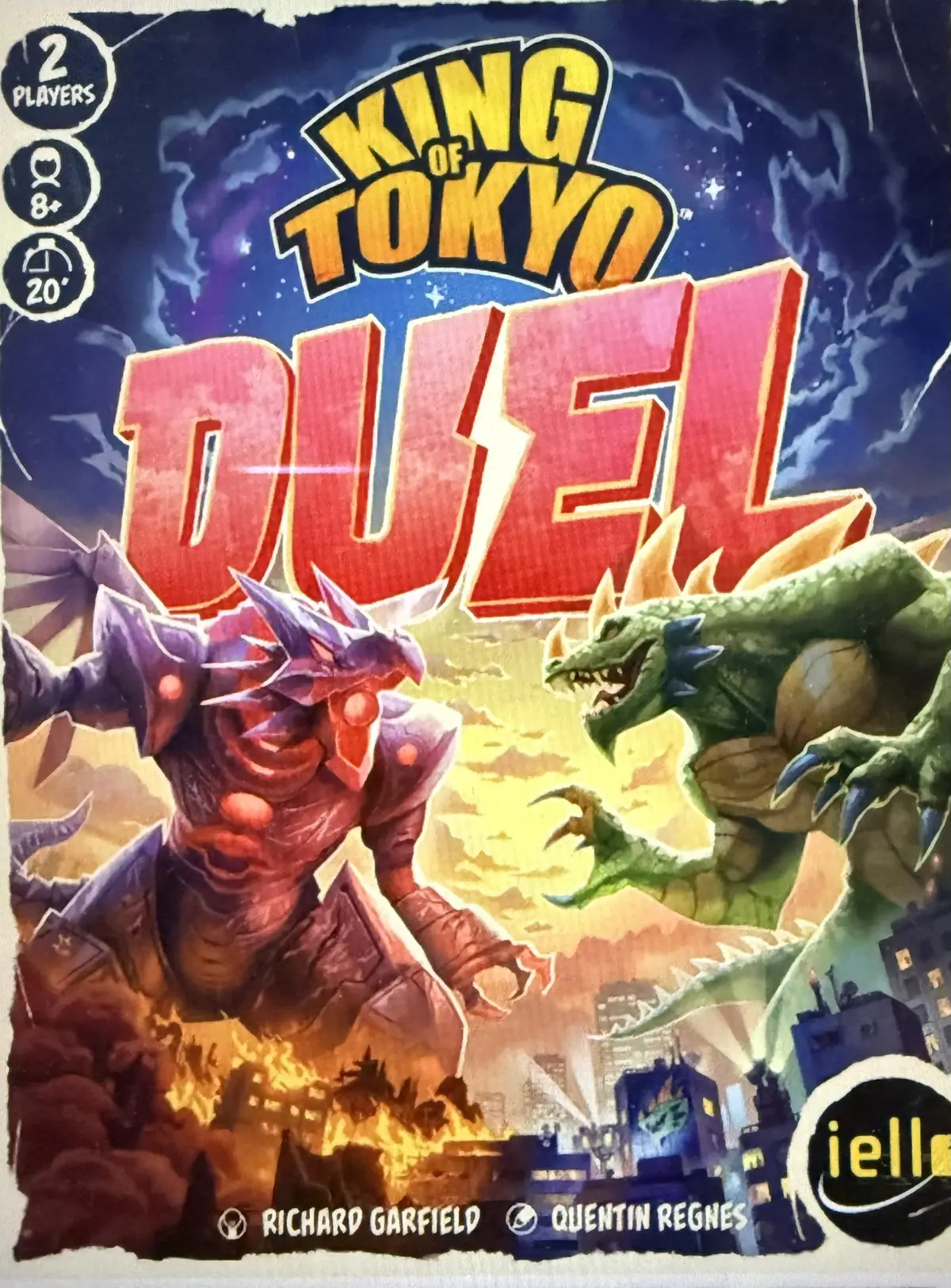
King of Tokyo Duel
- Age Rating: 8+
- Players: 2 Players
- Game Time: 20 Minutes
- Game Style: Dice Rolling / Monster Combat
How to Play King of Tokyo Duel : Turn Overview –
Your turn consists of four phases:
Phase 1: Roll Dice
- Roll 6 dice. You can reroll any number of them up to 3 times.
- Extra Dice: Before your first roll, you may spend up to 2 Dice Tokens to roll 1 extra die per token (max 8 dice total).
Phase 2: Resolve Dice
- Resolve your final dice in any order:
- Smash (Claw): Rival loses 1 Health per symbol.
- Heal (Heart): Gain 1 Health (up to your monster’s max).
- Energy (Bolt): Gain 1 Energy cube.
- Fame (Star) / Destruction (Building): * A set of 3 matching symbols pulls that marker 1 space toward you.
- Every additional matching symbol pulls it 1 more space.
- Special Power (!): Check your Monster Board. Rolling the required amount of “!” allows you to activate your unique ability (can be used multiple times if you have enough symbols).
Phase 3: Buy Cards or Gain Energy
- Buy: Purchase Power Cards from the market. The card on the far right always costs 1 less.
- Sweep: Spend 2 Energy to discard the market and draw 3 new cards.
- Pass: If you buy nothing, gain 1 Energy.
- Buzz Tokens: Some cards let you place “Buzz” bonuses on the tracks. If a marker lands on one, you immediately get the bonus (Energy, Health, etc.).
Phase 4: End Turn
- Resolve any “End of Turn” card effects and pass the dice.
How to Win
- The game ends immediately if you meet any of these conditions:
- Knockout: Your rival’s Health reaches 0.
- Ultimate Celebrity: You pull both the Fame and Destruction markers into your Spotlight Zone (the 3 marked spaces near your end of the track).
- Grand Finale: You pull either marker to the very last Victory Space on your side.
My family loves this game and its talked about for its family game appeal. Kids love it and it has a fantastic mix of luck, skill and complexitity to be loved by all.
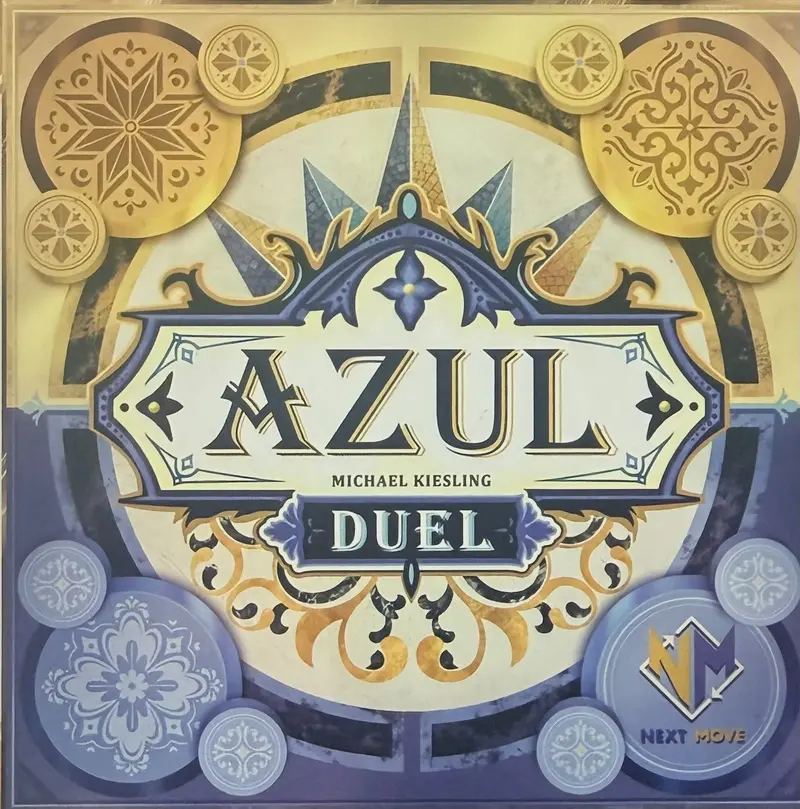
Azul Duel
- Age Rating: 10+
- Number of Players: 2
- Game Time: 30–45 minutes
- Objective: Score the most points by drafting colored tiles to complete specific patterns on your “Dome” plates within your palace ceiling.
- Game Type: Abstract Strategy / Tile Placement
How to Play Azul Duel
The game is played over five rounds, each consisting of three phases. Your goal is to skillfully acquire tiles to complete the patterns on your Dome-plates and score the most points.
Phase 1: Acquisition
- Players alternate turns performing one of four actions until all tiles and Bonus chips are gone.
- A) Take a Dome-plate: Place a Player token on the board to take one of the three face-up plates, or pay 1 point to draw a mystery plate from the pile. Place it on your board immediately.
- B) Take Tiles from a Factory: Pick all tiles of one color from a Factory “sun.”
- The remaining tiles move to that Factory’s “moon.”
- If you take the last tiles from a small Factory, its Bonus chip is revealed.
- C) Take Tiles from the Moons: Pick all tiles of one color from the top of the stacks on all Factory moons.
- Note: The first person to take tiles from the Large Factory’s moon must take the Starting Player tile (-2 points).
- D) Take a Bonus Chip: If a Bonus chip is revealed, spend an action to collect it. These are essential for completing lines later.
- The Pattern Lines: Any tiles you pick up must be added to one of your 6 pattern lines. If you have more tiles than the line can hold, the extra tiles fall into your Broken Tiles space (costing you points later).
Phase 2: Dome-Tiling & Scoring
- Both players resolve this phase simultaneously, moving tiles from complete pattern lines to their Dome.
Move Tiles: For every full pattern line, move one tile to a matching colored space on a Dome-plate.
Scoring:
1 Point: If the tile is placed alone.
Linked Points: If the tile touches others, count the total number of connected tiles in that row and column (including the new one).
Special Plates: If you fill a “Special plate,” you get to add a Special Tile and score the bonus points shown for that row.
Bonus Chips: You can spend pairs of matching Bonus chips (or any three chips) to act as a missing tile to complete a line.
Clean Up: Incomplete lines stay on your board for the next round. Unplaceable tiles become “Broken” and reduce your score.
Phase 3: Preparation
- (Skip this in Round 5)
- Retrieve your two Player tokens.
- Refill the Dome-plate display to 3.
- Refill the Factories with tiles and new Bonus chips.
- The player with the Starting Player tile begins the next round.
Game End
- The game ends after the 5th round. After final tablet scoring, the player with the highest score wins. If there is a tie, the player currently holding the Starting Player tile takes the victory!
Quick Tip: Pay attention to the “Large Factory.” Taking tiles from there early gives you a great selection, but that -2 point penalty for the Starting Player tile can be the difference between winning and losing in a close game!

Naishi
- Age Rating: 10+
- Number of Players: 2
- Game Time: 20 minutes
- Objective: Build the highest-scoring 10-card tableau, consisting of 5 visible cards and 5 hidden cards.
- Game Type: Tableau Building / Hand Management / Memory
- How to Play: Set in the Japanese Imperial Court, players draft cards from a central “River.”
- You manage a “Line” of five cards on the table and a “Hand” of five cards. On your turn, you discard a card from either your line or hand to take a new one from the river.
- You can also use “Emissary” tokens to manipulate the board or even “steal” a card from your opponent.
- At the end of the game, you reveal your hidden hand and score based on the unique positioning and adjacency of all 10 cards.
I find the gameplay in Naishi to be impressively straightforward and smooth. The turns are quick, which really ramps up the back-and-forth tension between my partner and me.
It is a fast-paced experience, making it ideal for those evenings when we are short on time. I love that the rules are easy to learn; I can have it set up, played, and packed away in under 30 minutes.
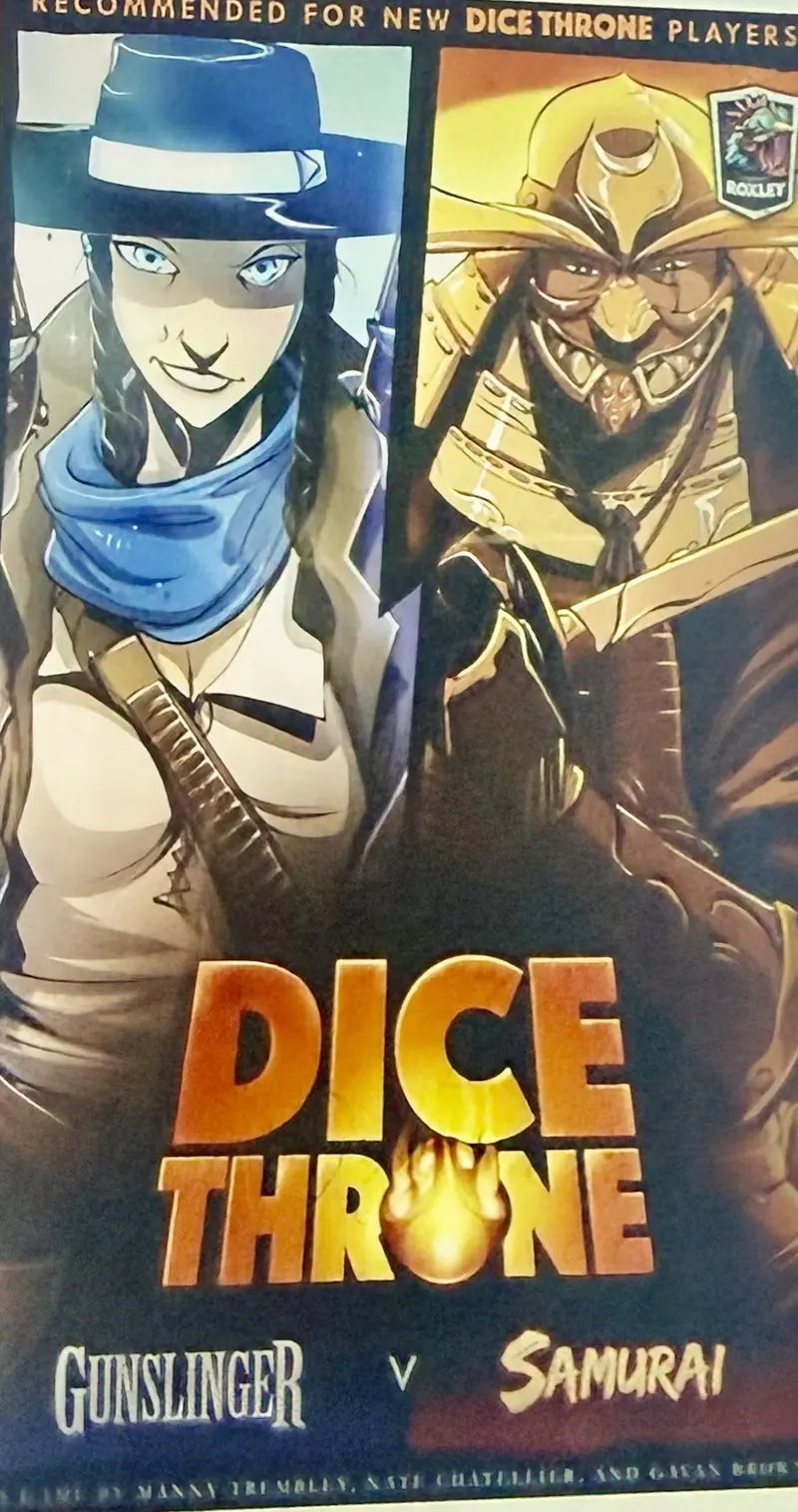
Dice Throne
- Age Rating: 8+
- Number of Players: 2–6 (Best at 2)
- Game Time: 20–40 minutes
- Objective: Reduce your opponent’s health to zero using unique hero abilities.
- Game Type: Combat / Dice Rolling (Battle Yahtzee)
- How to Play: Each player chooses a hero (e.g., Barbarian, Moon Elf) with a unique board and set of dice. On your turn, you roll your 5 dice up to three times to activate offensive abilities.
- You can spend “Combat Points” (CP) to play cards that upgrade your hero or manipulate dice rolls.
- If you are attacked, you get a “Defensive Roll” to mitigate damage or strike back. It’s fast-paced, asymmetric, and highly tactical.
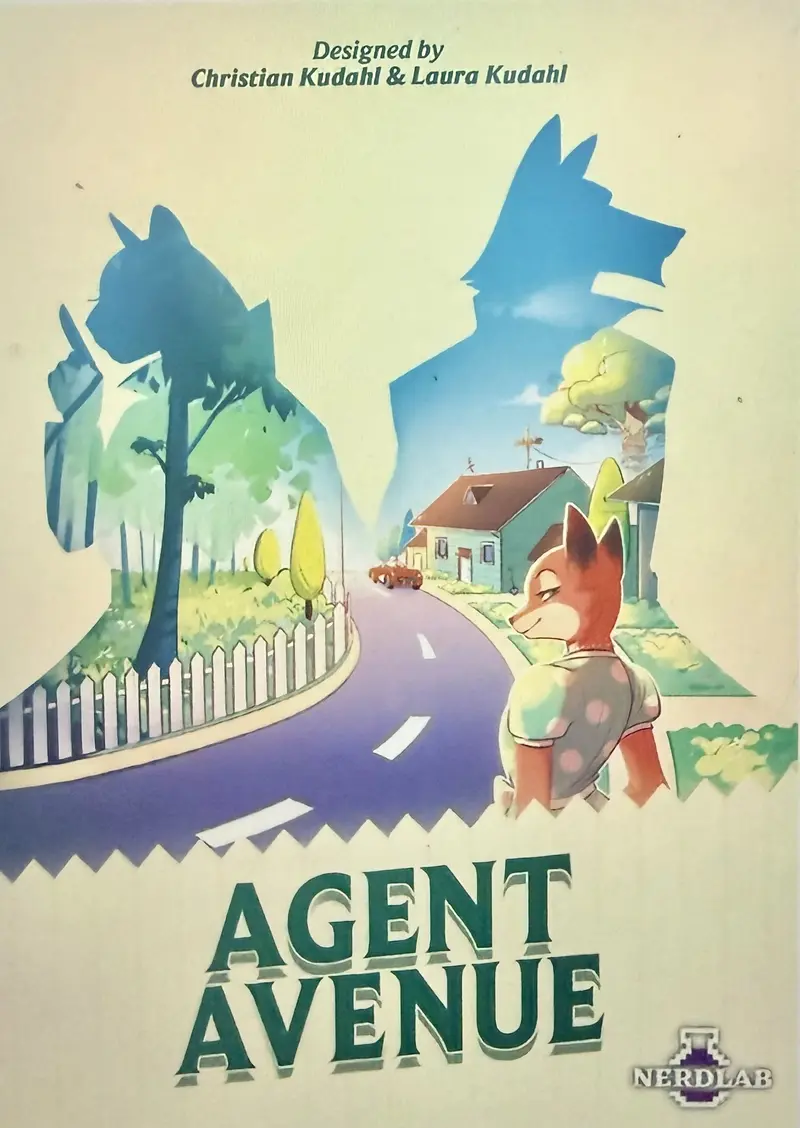
Agent Avenue
- Age Rating: 8+
- Number of Players: 2 (4 in team mode)
- Game Time: 10–20 minutes
- Objective: Unmask your opponent by catching their spy meeple on the board or by collecting 3 “Codebreaker” cards.
- Game Type: Bluffing / “I Cut, You Choose” / Race
- How to Play: Two rival spies live in a 1950s animal suburb.
- On your turn, you play two agent cards—one face-up and one face-down.
- Your opponent chooses one card to take and move their meeple; you take the remaining card and move yours.
- The trick is that cards have different movement values depending on how many of that “set” you’ve already collected.
- You win by landing on your opponent’s space, collecting 3 Codebreakers, or avoiding the 3 “Daredevils” that cause an instant loss.
There is something uniquely special about sitting down across from just one other person. While big group game nights are full of laughs and chaos, 2 player board games offer a different kind of magic. It’s more personal, more focused, and—let’s be honest—a lot easier to schedule!
For me, the joy of a great duo game is in the “connection through competition.” Whether I’m playing a morning game of Boop over coffee or ending the day with a high-stakes match of Raptor, these moments have become my favorite way to unplug.
Frequently Asked Questions
2 Player Games FAQs
What makes a board game "good" for exactly two players?
The best two-player games focus on “tight” mechanics where every move you make directly impacts your opponent. Look for games designed specifically for a “duel” (like Azul Duel or 7 Wonders Duel) or those with “scaling” rules that keep the board from feeling too empty with only two people.
Is Azul Duel different from the original Azul?
Yes! While it shares the same beautiful tile-drafting feel, Azul Duel is balanced specifically for two. It introduces “Bonus Chips” and “Dome Plates” that add more strategic depth and prevent the “runaway leader” problem sometimes found in the 4-player version.
Are cooperative or competitive games better for couples?
It depends on your “gaming personality!” If you enjoy working toward a shared goal without the stress of “attacking” each other, cooperative games like Codenames Duet or Fox in the Forest Duet are perfect. If you love outsmarting your partner, competitive duels like Splendor Duel provide that satisfying strategic “tug-of-war.”
How much "luck" is involved in Dice Throne?
While Dice Throne uses dice, it is not a game of “pure luck.” You have three rolls per turn (similar to Yahtzee) and a hand of cards that allow you to manipulate your dice or your opponent’s. It’s about managing probability and knowing when to play your cards to turn a bad roll into a winning move.
Conclusion
This selection is some all time favourites like Boop, Azul Duel but I’ve also included some recently published board games that are suitable as 2 player games.
Personally, I love that a great duo game doesn’t just fill time—it creates a unique way to connect and compete. From the asymmetrical, cat-and-mouse tension of Raptor to the deceptively “brain-burning” cuteness of Boop, these titles prove that a small table can still host a massive gaming experience.
For those who crave variety, the list on this page highlights some truly standout head-to-head board games.
If you’re a fan of monster-themed chaos, King of Tokyo Duel brings fast-paced dice-rolling fun, while Dice Throne offers a highly tactical “battle yahtzee” vibe that keeps every match feeling fresh. If you prefer something more strategic and visual, Azul Duel and the elegant tableau-building of Naishi are absolute must-tries for your next game night.
I’ve found that the best competitive 2 person board games are the ones that balance replayability with a quick setup, allowing you to dive right into the action.
Even niche gems like the bluffing-heavy Agent Avenue or the coastal strategy of Sea Salt & Paper (mentioned in our styles below) offer layers of depth that keep you coming back for “just one more round.”
Looking for even more inspiration? Check out our deep dive into the Top 10 Most Popular Two-Player Games or explore our guide on Quick Dice Games. Grab a friend, set up the board, and let the games begin.
Check out these game styles below:
- Solo Board Games
- Left Center Right—Popular Dice Games
- Social Deduction Games
- Best Family Games
- Roll and Write Games
- Easy dice games for the whole family
- Tacta – Strategy card game
- Sea Salt & Paper – another fab two person game
- Splendor Duel is not on this list but is highly recommended. I didn’t include it because its so popular that I thought you probably know of it. If not, definitely check this one out.