
Learning math is an essential part of life, and its important to start off your child’s educational journey so it doesn’t feel like a chore. So how can we help our child learn the basics of math early? One fabulous way is through play: playing educational maths board games.
Jump To Educational Maths Games
Introduce Simple Math Concepts through Play
Now is the perfect time to introduce some early math concepts in a playful way. Don’t worry about formal lessons—young children learn best through active exploration and play.
- Simple Addition and Subtraction: Use everyday situations (e.g., “You have two cookies, and I’ll give you one more. How many cookies do you have now?”) to introduce basic addition and subtraction.
- Patterns and Sequences: Create simple patterns with colored blocks or toys (e.g., red-blue-red-blue) and ask your child to continue the pattern. This builds an early understanding of sequences and logic. The board game Sequence for kids helps with patterns.
- Number Recognition: Use flashcards, chalk, or a dry erase board to practice number writing and recognition. You can make this into a fun activity by turning it into a “number scavenger hunt” where your child has to find and point to numbers around the house.
- Be Positive and Patient. Children at this age are naturally curious, and math can be a fun and exciting challenge. Approach math with a positive attitude—celebrate the small wins and be patient when they struggle. Emphasize effort over results and remind them that mistakes are part of learning.
Sing Songs and Rhymes with Numbers
Music and rhymes are excellent tools for helping young children memorize numbers and math concepts. Many children’s songs incorporate counting, shapes, and simple math operations in a fun, rhythmic way. Choose a themed maths board game around their favourite TV show or movie and if they have a favourite song or actions, incorporate that into the game you are playing.
- Counting Songs: Songs like “Five Little Ducks” or “One, Two, Buckle My Shoe” help children practice counting forward and backward in a catchy way.
- Shape Songs: Songs like “This Old Man” or “The Shape Song” reinforce basic shape recognition and spatial awareness.
- Rhymes with Numbers: Recite number rhymes, or make up your own number-based rhymes to engage your child. Repetition helps reinforce math concepts.
Play Maths Board Games
Maths board games are a fantastic way to introduce math concepts while keeping your child engaged. Whether you are using board games, card games, or simple homemade games, math doesn’t have to feel like work—it can be fun!
- Counting Games: Simple maths board games that involve dice or moving pieces along a path are perfect for reinforcing counting skills. Games like Chutes and Ladders or Candy Land involve counting spaces, and they can help children practice their number recognition and sequence skills.
- Shape Recognition: Use shape-based games like puzzles or shape-matching games to help your child recognize geometric shapes. You can also introduce “shape hunts,” where they search for objects in the house that match certain shapes.
- Board Games: Games like Connect Four or Uno can help children with pattern recognition, matching, and even basic math operations like addition and subtraction.
- Card Games: Simple card games like Go Fish or Memory can be used to help your child recognize numbers and develop an understanding of pairs, matching, and number values.
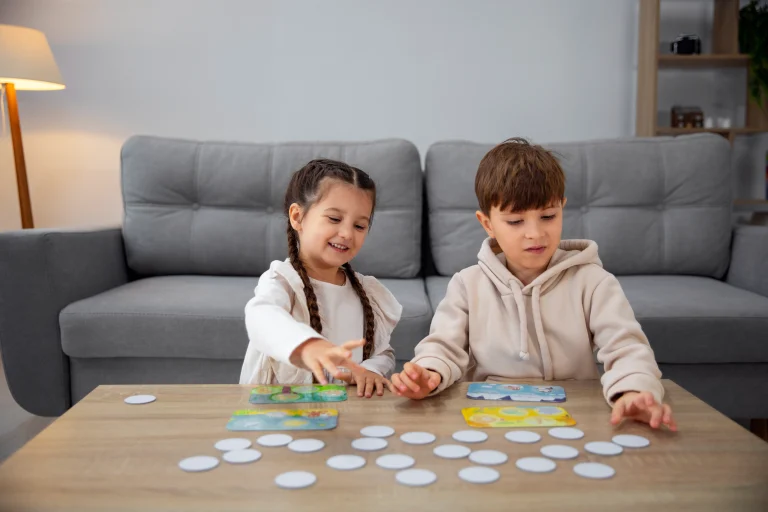
These educational math board games offer a fantastic way to introduce young children to mathematical concepts in a fun and interactive manner. By playing board games, children develop essential math skills like counting, number recognition, addition, subtraction, and spatial reasoning. A great way to help children be school-ready.
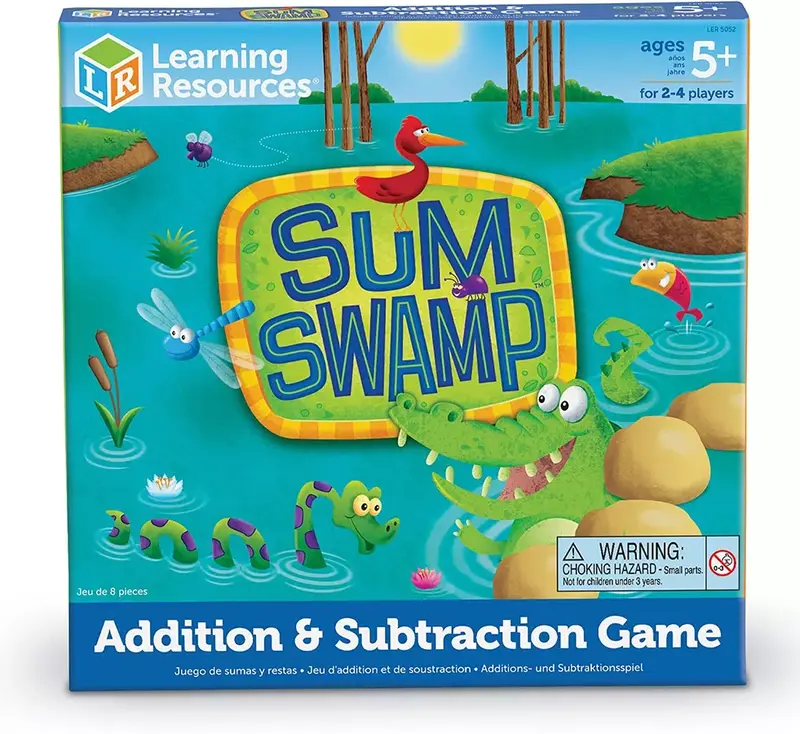
- 15-20 mins
- Age Rating 5+
- Number of Players 2-4
I found Sum Swamp is a delightful game that introduces simple addition and subtractions.
Another great Learning Resource game developed as an educational maths board games for preschoolers. This game helps children visualize addition and develop number sense.
How to Play Sum Swamp
What’s in the Box?
- 1 Game Board
- 4 Little Critter Pawns
- 2 Number Dice
- 1 Operation Die (+ / –)
Setup
- Place the game board in the center of the table.
- Each player chooses a critter pawn and places it on the Start space.
- Roll a number die. The player with the highest number takes the first turn.
How to Take a Turn
- Roll all three dice (2 number dice and 1 operation die).
- Create a number sentence using:
- The highest number first
- The operation die second
- The lowest number last
- Solve the equation.
- Move your pawn forward the answer.
Example
If you roll:
3 + 2 = 5
Move forward 5 spaces.
If you roll:
5 – 5 = 0
Do not move this turn.
After moving, play passes to the next player.
How to Win
Be the first player to reach the Finish space.
Players do not need to roll the exact number needed to land on Finish.
Special Spaces
Evens and Odds Spaces
When you land on an Evens or Odds space:
- Roll one number die.
- If the result matches the space (even or odd), move forward that many spaces.
- If it does not match, stay where you are and try again on your next turn.
Number Spaces
When you land on a numbered space:
- Roll the operation die.
- If you roll a +, move forward the number shown on the space.
- If you roll a –, move backward the number shown on the space.
Short Cut Spaces
Land on a Short Cut space and follow the arrow shown on the board. This can help you move ahead much faster.
Endless Loop
When players enter the Endless Loop, they must follow the direction of the arrow and continue moving clockwise around the loop.
To escape the loop, land on the exit space indicated on the board and continue your journey toward the Finish.
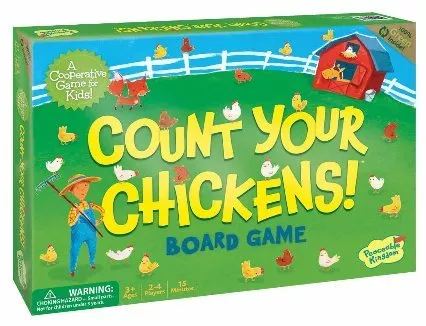
- 10-15 mins
- 3+
- 2-4 players
How to play Count Your Chickens
We enjoyed this because it was a cooperative board game. We have a sensitive child, so this really resonates that there isn’t a winner. And found we enjoyed working together to help Mother Hen collect her chicks and bring them back to the coop. Created a lovely connection by us, talking about “we”: “will we win” , “what will we do next” etc.
What’s in the Box?
- 1 Game Board
- 1 Mother Hen with Stand
- 1 Spinner
- 40 Baby Chick Tokens
Objective
The Baby Chicks have escaped from the coop and are scattered across the farm. Players must work together to help Mother Hen gather every chick and return them safely to the coop before she reaches the end of the path.
Unlike most board games, Count Your Chickens! is a cooperative game. Instead of competing against one another, everyone works as a team. As a result, players either win together or lose together.
Setup
Before the game begins:
- Open the game board and place it on a flat surface.
- Put Mother Hen on the Start space.
- Scatter all 40 Baby Chicks around the farm area, making sure they are not placed on the path.
- Place the spinner within easy reach of all players.
Once everything is ready, you’re ready to start collecting chicks!
How to Play
On a player’s turn:
- First, spin the spinner.
- Next, move Mother Hen forward along the path until she reaches the next space that matches the picture on the spinner.
- As Mother Hen moves, count each space aloud.
- Then, collect the same number of Baby Chicks from anywhere on the board.
- Finally, place those chicks inside the coop.
After all the chicks have been collected, the next player takes a turn.
Example
If Mother Hen moves forward 4 spaces, players collect 4 Baby Chicks and place them in the coop.
Working Together
Since this is a cooperative game, players are encouraged to help one another throughout the game. For example, everyone can:
- Count spaces aloud together.
- Help younger players identify matching pictures.
- Remind each other what to do during a turn.
- Celebrate each chick safely returned to the coop.
How to Win
The game ends when Mother Hen reaches the final space on the path.
If all 40 Baby Chicks have been returned to the coop before Mother Hen reaches the end, the entire team wins!
However, if Mother Hen reaches the last space and some chicks are still loose on the farm, the team loses. Fortunately, the chicks are ready for another adventure, so simply reset the game and try again.
- 15-20 mins
- 3+
- 2-4 players
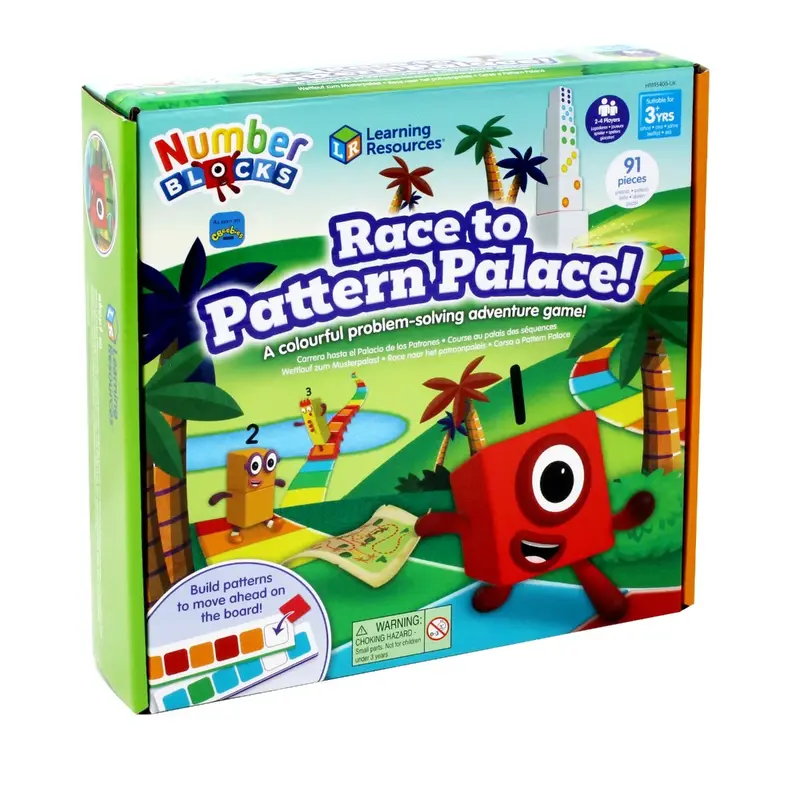
Objective
Race around the board, build colorful pattern bridges, and be the first player to reach Pattern Palace.
Along the way, players practice pattern recognition, color matching, and counting while helping their Numberblock character travel across bridges and shortcuts.
What’s in the Box?
- 1 Game Board
- 4 Numberblocks Pawns with Stands
- 1 Dice Popper
- 4 Bridges
- 25 Bridge Tiles
- 40 Pattern Cards
- 20 Level 1 (Green) Cards
- 20 Level 2 (Purple) Cards
- 16 Six’s Tricks Cards
Setup
Before the game begins:
- Each player chooses a Numberblocks pawn and matching bridge.
- Place all pawns on the Start space.
- Sort the Pattern Cards into:
- Level 1 (green)
- Level 2 (purple)
- Shuffle each deck separately and place them face down near the board.
- Shuffle the Six’s Tricks Cards and place them face down nearby.
- Place the Bridge Tiles in a pile beside the board.
- Finally, place the Dice Popper in the center of the game board.
How to Play
The youngest player goes first.
On a turn:
- Press the Dice Popper.
- Follow the result.
- Play then passes clockwise to the next player.
If You Roll a Color
Move your pawn to the next matching color space on the path.
If You Roll a 6
Draw a Six’s Tricks Card and follow its instructions immediately.
Building Pattern Bridges
As players move around the board, they should watch for bridge-building opportunities.
Multicolor Spaces
If a multicolor space appears before the next bridge and you roll any color that allows you to reach it, stop there and build a pattern bridge.
To build a bridge:
- Draw a Level 1 or Level 2 Pattern Card.
- Place the card on the bridge space.
- Put your bridge on top of the card.
- Use Bridge Tiles to recreate the pattern shown.
Some colors may be missing from the pattern.
In that case, determine what color comes next and complete the sequence.
Crossing the Bridge
Once all six tiles have been placed correctly:
- Check the answer key if needed.
- Cross the bridge.
- Stop on the space immediately after the bridge.
- End your turn.
- Return the tiles to the draw pile.
- Place the completed Pattern Card in a discard pile.
Beginner Tip
Start with Level 1 cards to practice simple two-color patterns.
Once players feel confident, move on to the more challenging Level 2 patterns.
Special Spaces
Throughout the game, players will encounter several special spaces.
Arrow Shortcut
If you roll the color of the next arrow space:
- Move onto the arrow space.
- Draw a Pattern Card.
- Build a bridge.
- Cross the shortcut immediately.
This can help players reach Pattern Palace much faster.
Number Spaces
When landing on a numbered space, count on and move forward the number shown.
For example:
- Land on a 2 space → Move 2 additional spaces.
- Land on a 4 space → Move 4 additional spaces.
Traffic Jam
If two or more players land on the same space, everyone stays there together until their next turn.
Six’s Tricks Cards
When a player rolls a 6, they draw a Six’s Tricks Card.
These cards can help or hinder progress by allowing players to:
- Move forward
- Move backward
- Move to the next bridge
- Move to the next matching color space
- Roll again
- Skip a turn
Some cards allow players to choose how far to move, creating opportunities to land on bridges, shortcuts, or number spaces.
Palace Slide
As players approach Pattern Palace, they may roll a color that no longer appears on the path ahead.
When this happens, they can use the Palace Slide and move directly into the Pattern Palace dice tower.
Sometimes luck is on your side!
How to Win
Continue building bridges, crossing shortcuts, and navigating Six’s Tricks until someone reaches Pattern Palace.
The first player to reach the Pattern Palace dice tower wins the game!
Dive into two levels of gameplay on this number-filled adventure, designed to enhance pattern and color recognition, counting, and more. This educational math game for preschoolers includes a beginner card deck and a challenge deck for more advanced play.

- 15-20 mins
- 3+
- 2-4 players
How to play Candy Land
Candy Land is a classic game that introduces children to basic counting and color recognition. This math learning game was designed by Eleanor Abbott and first published in 1949 and has been a household hit since.
Objective
Race through the colorful world of Candy Land and be the first player to reach Home at the end of the path.
Players move by drawing cards that match the colored spaces and character locations on the board.
Setup
Before the game begins:
- Shuffle the deck of Candy Land cards.
- Place the cards face down within easy reach of all players.
- Each player chooses a playing piece.
- Place all playing pieces on the Start space.
- The youngest player takes the first turn.
How to Play
On a player’s turn:
- Draw the top card from the deck.
- Move forward along the path according to the card drawn.
- Play then passes to the next player.
Continue taking turns until one player reaches Home.
Moving with Color Cards
Most cards show one or two colored squares.
Single Color Card
If a card shows one color, move forward to the next matching colored space on the path.
Double Color Card
If a card shows two matching colors, move forward to the second matching colored space on the path.
Moving with Picture Cards
Some cards feature special Candy Land characters or locations.
When a picture card is drawn:
- Move directly to the matching picture space on the board.
- This may move a player forward or backward.
- On the next turn, continue moving from that space.
Special Paths
Along the journey, players may encounter shortcuts.
Mountain Pass
If a player lands exactly on the start of the Mountain Pass, they immediately move to the other end of the shortcut.
Rainbow Trail
Likewise, landing exactly on the beginning of the Rainbow Trail allows a player to move directly to the end of the path.
Players can only use these shortcuts when they stop exactly on the starting space.
Special Spaces
Throughout the game, players may land on special spaces such as:
- Cherry Pitfalls
- Molasses Swamp
When this happens, simply follow the instructions printed on the board.
Additional Rules
Keep these rules in mind during play:
- Two or more players may occupy the same space.
- If the card deck runs out, shuffle the cards and continue playing.
- Players always move according to the card they draw, even if it sends them beyond other players.
Reaching Home
A player reaches Home by:
- Landing on the final blue space, or
- Drawing a card that would move them beyond the final blue space if the path continued.
How to Win
Eventually, one player will make it all the way through Candy Land.
The first player to reach Home wins the game!

- 10-15 mins
- 3+
- 2-4 players
Hi Ho! Cherry-O CoComelon is a charming game that teaches children about counting, turn-taking, and basic probability. This is a hugely popular learning maths board game for preschoolers.
You pick your choice of player; JJ, Cody, and Cece. Players spin the spinner and collect the pretend apples from their characters tree. The first player to get all 10 apples in their basket and shout, “CoComelon!” wins the game.
Kids can have so much fun picking pretend apples to fill their baskets, they don’t even realize they’re practicing counting, addition, and subtraction. This educational math game also helps with color matching, as the colour of each character has a matching apple tree to pick from.
There are different version of this board game, and you can buy the standard Hi Ho Cheery O game if your not a fan of CoComelon.
Research - Benefit of Board Games on Math Skills
Research titled “The Effects of Board Games on Math Skills in Children” via (Taylor and Francis online) shows promising results for using board games to improve math in young kids. According to the overview:
In about 52% of studied tasks, children showed significant improvement when comparing their skills before and after participating in board game interventions.
When comparing children who used board games (intervention groups) with those who did not, 32% of the studies found clear, statistically meaningful advantages in math skills for the group that used board games.
These benefits were especially noticeable in children aged roughly 45.6 to 100.6 months (that’s about 3.8 to 8.4 years old), showing that board games can help achieve measurable math skill gains in early childhood.
Keep Exploring and Learning
There are plenty of options for board games for preschoolers that build connection, learning, and patience. Head over to our age group page 3-5 years to explore.
Our top articles are